
Contenuti
- Every entrepreneur’s dilemma: card or digital?
- The traditional card: a classic that costs more than you think
- How much does the card REALLY cost (spoiler: more than €300)
- Operational limits (those that make you mad)
- Digital stamping: how it works (and why it’s different)
- How it works in practice (it’s easier than you think)
- The real advantages (those that really matter)
- Direct comparison: the numbers speak for themselves
- How much does digital stamping really cost (transparent numbers)
- Market prices (no surprises)
- Practical example: company with 10 employees
- When should you go digital (spoiler: almost always)
- Do you have employees who work offsite
- You waste time managing attendance manually
- Do you have doubts about the stampings
- Do you want to grow without complications
- The accountant asks you for your data digitally
- How to switch from card to digital (stress-free)
- Step 1: Choose the right system (5 minutes)
- Step 2: Configure the system (10 minutes)
- Step 3: Train employees (15 minutes total)
- Step 4: Test period (1-2 weeks)
- Step 5: Delete the tag
- The 3 best solutions for Italian SMEs
- 1. GeoTapp — Simplicity for SMEs
- 2. Zucchetti Attendance
- 3. TeamSystem Attendance
- Frequently Asked Questions (the real ones)
- Is it legal to track the location of employees?
- Can employees stamp for others?
- What happens if the employee forgets their smartphone?
- Do you need an internet connection to stamp?
- How long does it take to learn how to use it?
- Can I export data for the accountant?
- Conclusion: which one to choose for your SME?
- Try GeoTapp free for 15 days
Every entrepreneur’s dilemma: card or digital?
Let’s be clear: if you manage an SME, the issue of ’employee attendance’ is one of those headaches that you would like to solve once and for all.
Onthe one hand, you have the old timestamp. You know him well: that machine that has been there for years, the paper cards to be collected at the end of the month, the hours to be calculated by hand (or almost). It works, sure. But does it really work well?
On the other hand, you hear about digital stamping, app, geolocation, cloud. It sounds cool, but you wonder: “Is it really worth it? Or is it just another technological complication they want to sell me?
”Well, I’m here to give you an honest answer. With real numbers, pros and cons of both systems, and zero commercial fudging.
Spoiler: The answer might surprise you. And save you a lot of money.
The traditional card: a classic that costs more than you think
Let’s start with the system you probably know best: the good old time card.
The employee arrives, sticks the card in the machine, clicks, stamped. End of round, same story. At the end of the month, you collect everything, check, calculate the hours, and pass the data to the accountant or payroll software
.Simple, isn’t it? Yes, up to a point.

How much does the card REALLY cost (spoiler: more than €300)
When you think of the card, you only think of the cost of the machine. Like $500 one time, and you’re good to go for years. Right?
Wrong. The real costs are much higher, and hardly anyone calculates them
.Direct costs (what you see):
- Timing machine: €300-800 (one-time)
- Paper cards: €15-25 per month for 10 employees
- Annual maintenance: €100-200 (if it breaks, even more)
- Replacement every 5-7 years: another €500-800
Hidden costs (those you DON’T see, but you pay):
- Your time (or that of the secretary): 3-5 hours a month to collect cards, check anomalies, calculate hours, prepare reports. If we value this time at €30-50/hour, we are talking about €150-250 per month. That is, €1,800-3,000 per year.
- Miscalculations: Human errors happen. Industry studies estimate that they cost 2-4% of the total number of hours. For an SME with 10 employees, it means hundreds of euros wasted.
- Forgotten stamps: How many times does an employee forget to stamp? And you have to manage it manually, reconstruct the schedule, waste more time .
- Zero visibility on external employees: If you have people who work off-site, the card doesn’t tell you anything. Where are they? Have they arrived? Good.
Real annual total for an SME with 10 employees: €2,500-4,000.
And I’m not exaggerating. You do the math.
Operational limits (those that make you mad)
In addition to costs, there are practical issues that every entrepreneur knows very well:
❌ It only works on site — Do you have representatives? External technicians? Cleaning crews? The card is completely useless. You can’t carry the machine with you
.❌ No geolocation — You have no idea where the employee really is when they ring. Is it in the works? From the customer? At the colleague’s house who is doing him the favor? Mystery.
❌ The classic “rings for me too” — It happens. We all know that. A late employee asks his colleague to stamp for him. With the tag, it’s so easy
.❌ Manual management of everything — You must physically collect the cards, check them one by one, mark anomalies, calculate the hours. It’s pure work.
❌ Zero automation — No dashboards, no automated reports, no exports for the accountant. Everything by hand (or almost).
❌ Physical maintenance — The machine breaks, jams, runs out of ink. And when that happens, you’re stuck.
In short: the card works, but it costs you time, money and nerves.
Digital stamping: how it works (and why it’s different)
Now let’s move on to the digital system. What exactly is it?
In practice, the employee rings directly from the smartphone (or from a PC, or tablet). Open the app, press’ Enter ‘or’ Exit ‘, and the system automatically records everything on the cloud: time, GPS position (if required), any notes
.You, for your part, see everything in real time from a web dashboard or app. No paper, no machines, no manual calculations
.How it works in practice (it’s easier than you think)
Here’s the full flow:
- The employee opens the app on his smartphone (or accesses from a browser)
- Press’ Enter ‘when the round starts
- The system automatically records: exact time, GPS position (only then, not during the whole shift), any note or photo
- At the end of the shift, press’ Exit ‘— same process
- You see everything in real time from the dashboard: who entered, who left, where they were, any anomalies
That’s all here. Nothing more, nothing less.
The real advantages (those that really matter)
Now, why should you consider digital? Here are the real benefits, without marketing:
✅ Works everywhere — Employees on site, outside, on the go, wherever they have a smartphone. Zero geographical restrictions
.✅ GPS geolocation — Check where the employee is when they ring. Not throughout the entire shift (it would be invasive and illegal), only at the time of stamping. In total compliance with the GDPR.
✅ Automatic calculation of hours — The system does everything: hours worked, overtime, breaks, leave. Zero manual calculations.
✅ Instant reports — Do you want data for the accountant? Export to CSV in 30 seconds. Want to see who worked the most hours this month? Real-time dashboard.
✅ Goodbye false stamps — With geolocation and personal authentication, “stamping for me too” becomes practically impossible.
✅ Total visibility — Live dashboard, notifications if someone forgets to ring, anomalies automatically reported.
✅ Zero maintenance — No machines to fix, no ink to change. Everything on the cloud, always up to date.
✅ Multi-device — smartphone, tablet, PC. The employee uses what he has.

Direct comparison: the numbers speak for themselves
Enough talk. Let’s put the two systems side by side and see who wins.
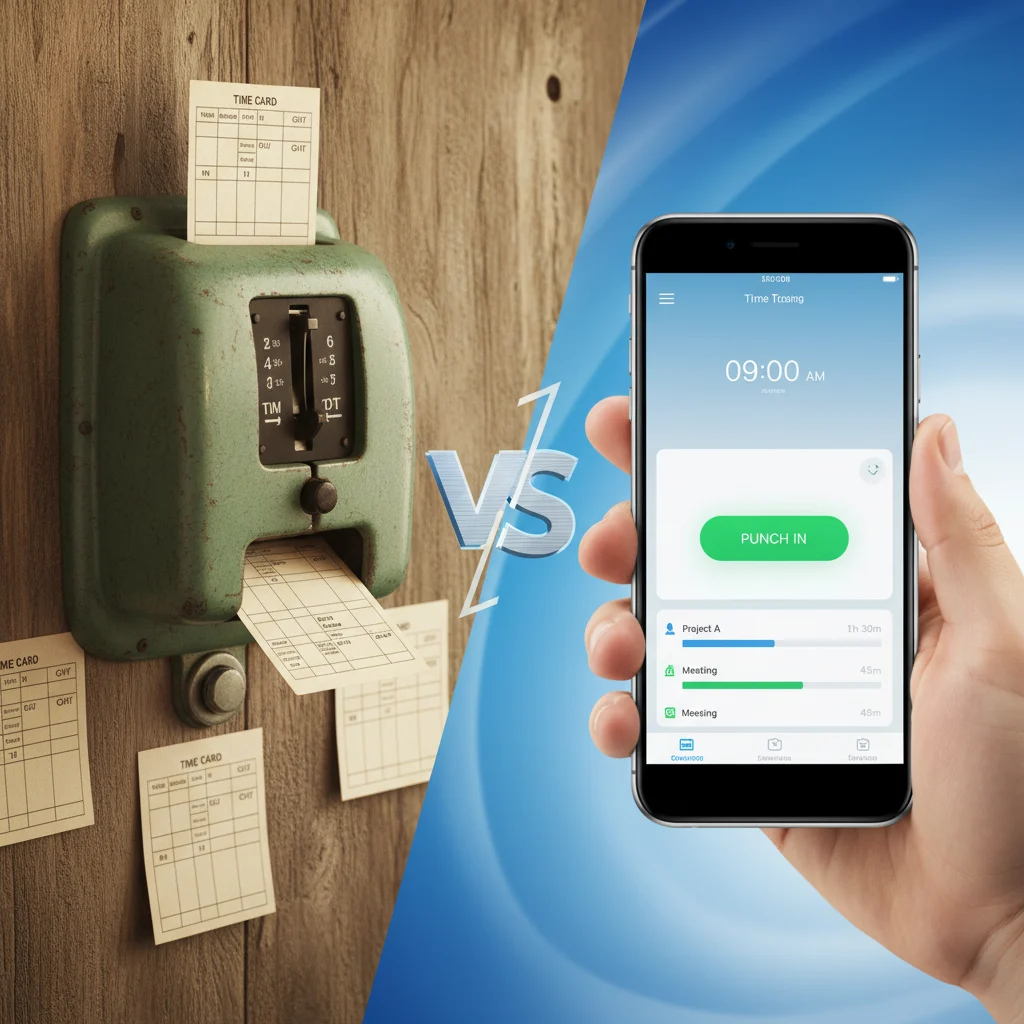
[INSERT IMAGE 2 HERE – Comparative infographic]
| Feature | Traditional tag | Digital stamping | ||||||||||||
|---|---|---|---|---|---|---|---|---|---|---|---|---|---|---|
| Initial cost | €300-800 €0 | (subscription only) | Monthly cost | €15-25+ admin time €1.5-2 | per employee | External employees | | |||||||
| Automatic time calculation | ❌ Manual | ✅ Automatic | Report and export | ❌ All by hand | ✅ CSV in 30 seconds | Administrative time | 3-5 hours/month | 5-10 minutes/month | Error risk | High (2-4%) Practically zero false stamping Easy | Almost impossible Maintenance Required Zero | Access | | |
| remote | ❌ On-site only | ✅ Everywhere | ||||||||||||
| Payroll integration | ❌ Manual | ✅ Direct export |
Look at the right column. Then look at the left one. And ask yourself: which system makes the most sense in 2025?
How much does digital stamping really cost (transparent numbers)
Okay, digital looks cool. But how much does it cost? Let’s talk about real money.
Market prices (no surprises)
Digital stamping systems in Italy have fairly standard prices:
- Enterprise solutions (Deputy, TSheets, Zucchetti): €8-15 per employee per month. They’re designed for large businesses, with advanced features that you probably don’t need.
- Solutions for SMEs (such as GeoTapp): €2-4 per employee per month. Everything you need, nothing more.
- Initial costs: almost always zero. No machines to buy, no expensive setups .
- Maintenance costs: zero. Everything on the cloud, automatic updates .
Practical example: company with 10 employees
Let’s deal with a real case.
Traditional system (card):
- Annual cost: €2,500-4,000 (machine + card + administrative time)
- Time spent: 40-60 hours per year
- Errors and inefficiencies: not quantifiable, but there are
Digital system (e.g. GeoTapp at €3/employee/month):
- Annual cost: €360 (€3 × 10 employees × 12 months)
- Time spent: 1-2 hours per year
- Errors: practically zero
Net savings: €2,000-3,500 per year.
Plus the recovery of 40-60 hours of your time (or those who manage the attendance). Hours that you can use to grow your business, not to count cards
.When should you go digital (spoiler: almost always)
The real question is: when does it make sense to take the leap?
Short answer: almost always. But let’s look at the specific cases.
Do you have employees who work offsite
If you manage external teams — representatives, technicians, cleaners, security personnel, installers — the card is completely useless.
Digital stamping with geolocation is the only practical solution. Point.
You waste time managing attendance manually
If you spend more than 2 hours a month collecting cards, checking anomalies, calculating hours, and preparing reports, you’re literally wasting time (and money).
Digital automates everything. Those 2-5 hours a month become 5-10 minutes.
Do you have doubts about the stampings
Do you suspect that someone stamps for others? That the delays are not recorded? That there are ‘favors between colleagues’?
Geolocation solves the root problem. It’s not obsessive control, it’s transparency
.Do you want to grow without complications
If you’re planning to hire new people, the digital system scales smoothly. Add an employee? Add an account. Fine.
With the card, each new employee is an extra card to manage, more administrative time, more complexity.
The accountant asks you for your data digitally
Export a CSV from a digital system: 30 seconds. Manually transcribe the cards into Excel: 2-3 hours.
You do the math.
How to switch from card to digital (stress-free)
Ok, you are convinced. You want to go digital. But how do you do it? Is it complicated?
No, it’s easier than you think. Here’s the full process.
Step 1: Choose the right system (5 minutes)
Evaluate the available options. For Italian SMEs, look for solutions that are:
- Simple to use — If your employees don’t understand the app in 2 minutes, it’s too complicated
- With geolocation — If you have external staff, it’s essential
- GDPR compliant — Required in Italy
- With support in Italian — When you have a problem, you want to talk to someone you understand
- Affordable — €2-4 per employee/month is the right range for SMEs
Step 2: Configure the system (10 minutes)
Modern systems like GeoTapp allow you to configure everything in a few minutes:
- Add employees (name, email, role)
- Set standard working hours
- Define any locations or work areas (for geolocation)
Done. Nothing more is needed.
Step 3: Train employees (15 minutes total)
Get the team together (or make a quick video) and show how it works:
- Download the app (2 minutes)
- Log in (1 minute)
- Stamp entry/exit (30 seconds)
- Add notes if necessary (30 seconds)
It’s so simple that it only takes 2 minutes of explanation. If they know how to use WhatsApp, they know how to use the stamping app
.Step 4: Test period (1-2 weeks)
Run the digital system parallel to the card for 1-2 weeks. So:
- Check that everything works
- Employees get used to it
- You calm down
Step 5: Delete the tag
After the test, remove the machine. Fine. You’ve gone digital.
Total time for the transition: less than 1 hour of your time.
The 3 best solutions for Italian SMEs
If you have decided to go digital, here are the options most suitable for Italian small and medium-sized businesses.
1. GeoTapp — Simplicity for SMEs
Ideal for: companies with external employees, mobile teams, representatives, small businesses that want zero complications
Strengths:
- Extreme simplicity (configuration in 5 minutes, really)
- Precise GPS geolocation (Google Maps)
- Honest price: €2-4 per employee/month
- Developed specifically for Italian SMEs (it is not a mistranslated American software)
- Direct support in Italian (talk to the person who made the product)
- 100% GDPR compliant
- Native Android/iOS apps coming soon (2025-2026)
Cost: €2-4/employee/month (annual subscription)
Free trial: 15 days, zero commitment
2. Zucchetti Attendance
Ideal for: companies that already use other Zucchetti products (payroll, management, etc.)
Strengths:
- Integration with the Zucchetti ecosystem
- Advanced features (maybe too many)
Limits:
- More complex to set up
- Higher cost: €6-10/employee/month
- Designed for medium to large companies, it can be overkill for SMEs
3. TeamSystem Attendance
Ideal for: professional firms and structured companies that already use TeamSystem
Strengths:
- Consolidated brand
- Integration with TeamSystem payroll software
Limits:
- Less intuitive interface
- Medium-high cost
- Longer learning curve
Frequently Asked Questions (the real ones)
Is it legal to track the location of employees?
Yes, but with precise rules. Geolocation is legal if
:- It is detected only at the time of stamping (not during the whole shift – that would be illegal)
- The employee is informed and has given explicit consent
- The company complies with the GDPR (protected data, clear purposes, limited storage)
Systems like GeotApp detect the position only when the employee presses’ Enter ‘or ‘Exit’. Not during work hours. It’s transparency, not obsessive control
.[Learn more: GDPR and geolocation — everything you need to know]
Can employees stamp for others?
With the tag? Yes, it happens often. All you have to do is have a colleague insert the tag for you.
With digital stamping? Practically impossible, because:
- Each employee has their own personal account with a password
- GPS geolocation verifies where the device is
- The system may require biometric recognition (optional, if you want to be even more secure)
What happens if the employee forgets their smartphone?
Modern systems have alternative solutions:
- Stamping from a PC or tablet (if available)
- Manual stamping inserted by the administrator afterwards
- Supporting note to recover later
It’s not a problem.
Do you need an internet connection to stamp?
It depends on the system. GeoTapp, for example, also works offline: the stamp is saved on the device and synchronized automatically when
the connection returns.So even in construction sites, cellars, areas with a weak signal: no problem.
How long does it take to learn how to use it?
Literally 2 minutes. If you know how to use WhatsApp or Facebook, you know how to use a digital stamping app
.It’s not complicated technology. It’s simple technology done well.
Can I export data for the accountant?
Yes, all modern systems allow export to CSV or Excel, compatible with any payroll software (Zucchetti, TeamSystem, Wolters Kluwer, etc.).
Click, export, done. 30 seconds.
Conclusion: which one to choose for your SME?
Okay, let’s recap. You’ve read everything, you’ve seen the numbers, you’ve understood how both systems work.
Now the question is: which one to choose?
The traditional card is only suitable if:
- You have less than 5 employees
- Everyone works on site, always, without exception
- You have time (and desire) to manage everything manually
- You don’t need reports, automations, or visibility
Honestly? These cases are increasingly rare.
Digital stamping is appropriate if:
- Do you have external or mobile employees (even just one)
- You want to save administrative time (who doesn’t want to?)
- Are you looking for precision and transparency?
- Do you want to climb without complications
- Your budget is €2-4 per employee/month (less than two coffees)
For the vast majority of Italian SMEs in 2025, digital is the right choice. It costs less, it saves time, it offers functionality that is impossible with the card
.And most importantly: it takes a headache out of your head.

Try GeoTapp free for 15 days
GeoTapp is the digital stamping system designed for Italian SMEs that want simplicity, not complications.
✓ Setup in 5 minutes ✓ No credit card required ✓ 30-day free trial ✓ Support in Italian ✓ No commitment
Or request a personalized demo and we’ll show you how it works for your specific business.
Manage the hours of your mobile staff
GeoTapp eliminates time disputes with verifiable GPS stamping, photographic evidence for each intervention and zero sheets of paper.
Keep reading
![How to choose an attendance recording software for SMEs [2025 Guide]](https://geotapp.com/blog/wp-content/uploads/2025/11/generated-image-2025-11-17-2-768x768.webp)
How to choose an attendance recording software for SMEs [2025 Guide]
18 March 2026
Who is GeoTapp’s ideal customer
18 March 2026
GeoTapp in 10 minutes: the owner’s console that puts you back in the center
18 March 2026
Business Expense Control: How to Track Fuel and Tolls Without Going Crazy
18 March 2026
What is GeoTapp in simple words
18 March 2026
Cleaning company: how much would your life change if every intervention were finally under control?
18 March 2026