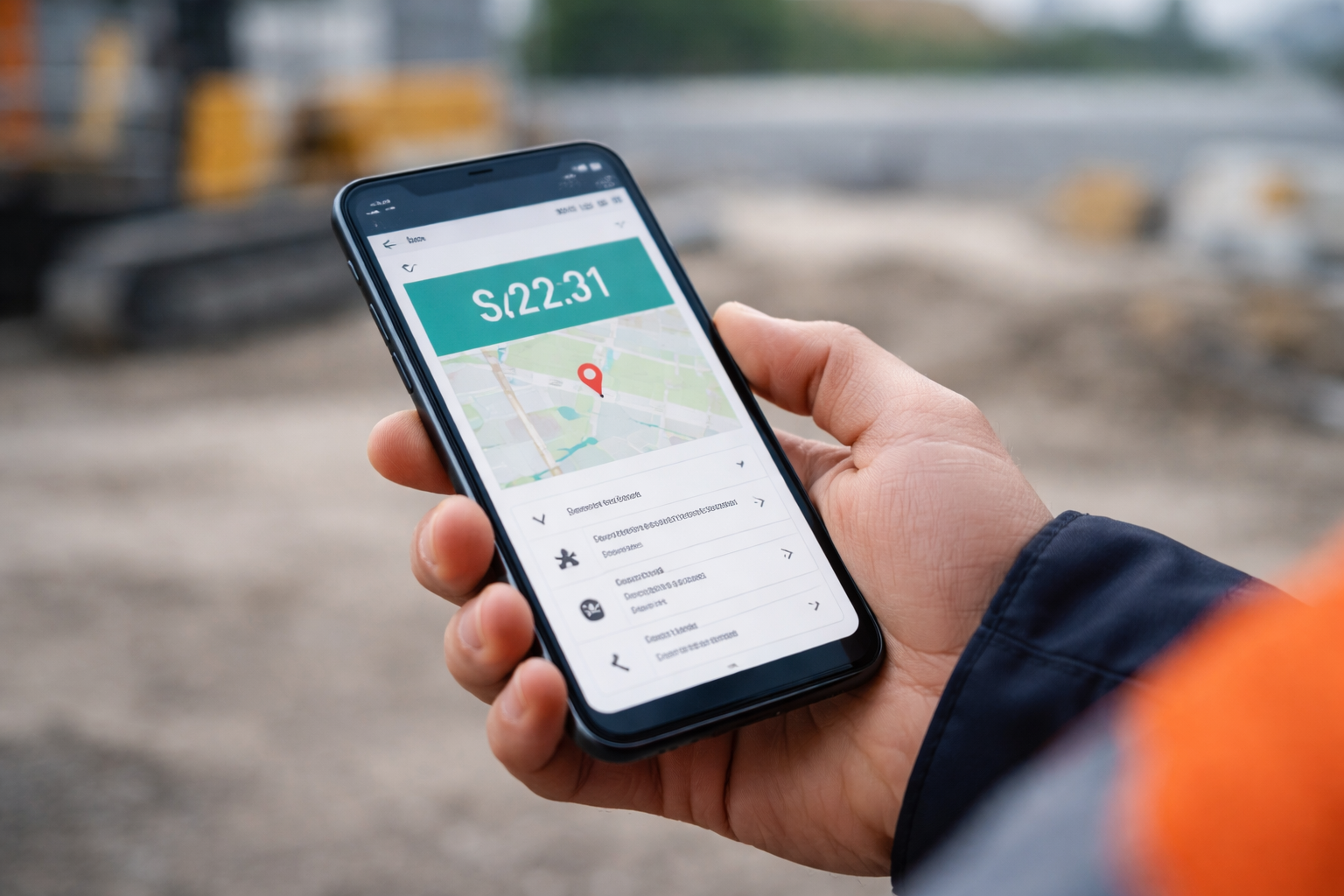

Your colleague is stamping for someone who isn’t here. And you probably don’t know it.
Buddy punching — when an employee stamps instead of an absent colleague — costs Italian companies an average of 2.2% of the annual number of hours. For a company with 20 employees at 1,800 hours/year, it means paying around 792 hours of phantom work each year. Translated into euros, with an average labor cost of 25€/hour, we are talking about almost 20,000 euros a year that come out of your current account without you realizing it
.
It’s not a trust issue. It’s a system issue. And GPS solves it — not because you monitor every movement, but because it makes it impossible to be in two places at the same time
.
How does buddy punching work in 2026
Before, it was simple: someone stamped a colleague’s card. Today, with digital systems, it is more sophisticated but equally widespread. The exchange of credentials is the most common form — you send a username and password to your friend, who stamps from home or car before you even arrive. The result is that the system shows an arrival time of 8:00 when the employee entered at 8:35. Thirty minutes a day, for twenty working days a month, makes you pay ten hours without having received anything in return
.
With app-based stamping systems without geolocation, the problem is even harder to identify because you don’t have any data to tell you where the phone was at the time it was stamped. You only see the time — and that time may be false.
Why the mobile app alone is not enough
Many companies have already made the switch from a paper tag to an app on the phone, thinking they have solved the problem. They actually moved the problem, not eliminated it. An app that only records the time is easily circumvented: the employee leaves the phone to a colleague, or the app works from any geographical location. Without GPS location verification, you’re simply replacing the physical tag with a digital tag — same problem,
new interface.
We need something that ties the stamp inextricably to the physical presence in the workplace. That’s exactly what GeoTapp does
.
How GeoTapp’s GPS eliminates buddy punching at the root
GeoTapp TimeTracker links each stamp to a precise GPS coordinate, detected at the exact moment the employee presses the button. It is not possible to stamp from the car in the parking lot if the construction site is 500 meters away — the system detects the distance from the configured work area and can block the stamping or report it as an anomaly. It is not possible to ring from home for a colleague because the position of the telephone does not match the place of surgery
.
In addition to geolocation, GeoTapp implements anti-spoofing controls that detect if the phone is simulating a false position through a mock location app or developer mode. These attempts to evade the system are automatically reported and the stamp is marked as suspicious, allowing
you to investigate before approving the hours.
The real calculation: how much are you losing now
Let’s do the math together. Take the number of employees in your company and multiply it by the average hourly cost, including contributions and charges. Apply a conservative percentage of 1.5% of “ghost” hours — less than the national average. For a small cleaning company with 15 employees at €20/hour, out of 1,700 hours per year each, buddy punching costs around €7,650 each year. For an installation company with 30 technicians at €28/hour, we are around
€21,000.
It is money that comes out silently, distributed over hundreds of small abnormal stampings that no one notices individually but that accumulate month after month. With GeoTapp, the system intercepts them automatically, without you having to do anything special
.
What Happens When Employees Know They Are Verified
There’s one side effect that many entrepreneurs don’t expect when they adopt GeotApp: anomalies shrink on their own, even before the system detects one. When employees know that every stamp is GPS-verified and anti-spoofing, buddy punching stops being a viable option. There’s no need for constant surveillance — it’s enough that the system exists and that everyone knows how it works
.
This also creates a fairer working environment: those who respect the schedule no longer feel at a disadvantage compared to those who arrive late and stamp early. Transparency doesn’t divide teams — it protects them.
Implementation in five minutes, results from day one
The question that many owners ask themselves is: “how long does it take to set up such a system?” With GeoTapp the answer is: less than an afternoon. Create the account, add employees (also via WhatsApp), configure construction sites or work areas with GPS coordinates, and the system is operational. Employees download the app from the App Store or Google Play — it’s free for them — and start stamping. You don’t need training, you don’t need IT, you don’t need to change any existing process.
From that moment on, every out-of-zone stamp is reported, every spoofing attempt is detected, and you have a real-time dashboard with the certified position of each stamp. If you’ve ever lost money on time disputes, it’s worth finding out how much you could recover
.
Keep reading
Digital Stamping vs Traditional Tag: SME 2025 Guide
18 March 2026
Business Expense Control: How to Track Fuel and Tolls Without Going Crazy
18 March 2026![How to choose an attendance recording software for SMEs [2025 Guide]](https://geotapp.com/blog/wp-content/uploads/2025/11/generated-image-2025-11-17-2-768x768.webp)
How to choose an attendance recording software for SMEs [2025 Guide]
18 March 2026
Who is GeoTapp’s ideal customer
18 March 2026
Cleaning company: how much would your life change if every intervention were finally under control?
18 March 2026
Why do SMEs lose money without knowing it: how Geotapp-Flow puts expenses, employees and inventory in order
18 March 2026