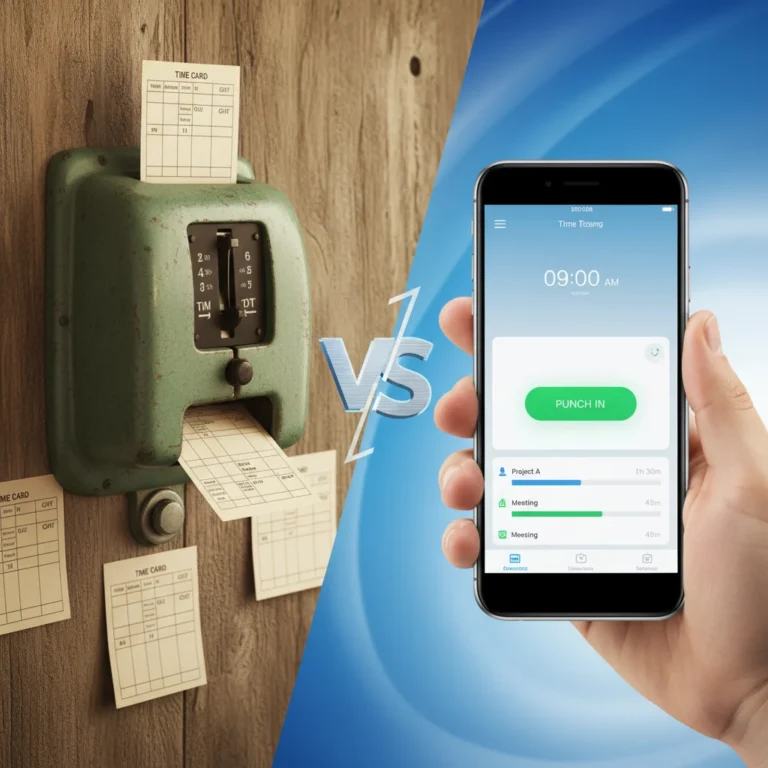
Every entrepreneur’s dilemma: card or digital?
Let’s be clear: if you manage an SME, the issue of ‘employee attendance’ is one of those headaches that you would like to solve once and for all.
Onthe one hand, you have the old timestamp. You know him well: that machine that has been there for years, the paper cards to be collected at the end of the month, the hours to be calculated by hand (or almost). It works, sure. But does it really work well?
On the other hand, you hear about digital stamping, app, geolocation, cloud. It sounds cool, but you wonder: “Is it really worth it? Or is it just another technological complication they want to sell me?
Before you renew another box of paper cards, give a digital clock-in a fortnight on a real shift.
No credit card, up and running in 2 minutes.
Open your trialWell, I’m here to give you an honest answer. With real numbers, pros and cons of both systems, and zero commercial fudging.
Spoiler: The answer might surprise you. And save you a lot of money.
The traditional card: a classic that costs more than you think
Let’s start with the system you probably know best: the good old time card.
The employee arrives, sticks the card in the machine, clicks, stamped. End of round, same story. At the end of the month, you collect everything, check, calculate the hours, and pass the data to the accountant or payroll software
.Simple, isn’t it? Yes, up to a point.

How much does the card REALLY cost (spoiler: more than €300)
When you think of the card, you only think of the cost of the machine. Like $500 one time, and you’re good to go for years. Right?
Wrong. The real costs are much higher, and hardly anyone calculates them
.Direct costs (what you see):
- Timing machine: €300-800 (one-time)
- Paper cards: €15-25 per month for 10 employees
- Annual maintenance: €100-200 (if it breaks, even more)
- Replacement every 5-7 years: another €500-800
Hidden costs (those you DON’T see, but you pay):
- Your time (or that of the secretary): 3-5 hours a month to collect cards, check anomalies, calculate hours, prepare reports. If we value this time at €30-50/hour, we are talking about €150-250 per month. That is, €1,800-3,000 per year.
- Miscalculations: Human errors happen. Industry studies estimate that they cost 2-4% of the total number of hours. For an SME with 10 employees, it means hundreds of euros wasted.
- Forgotten stamps: How many times does an employee forget to stamp? And you have to manage it manually, reconstruct the schedule, waste more time .
- Zero visibility on external employees: If you have people who work off-site, the card doesn’t tell you anything. Where are they? Have they arrived? Good.
Real annual total for an SME with 10 employees: €2,500-4,000.
And I’m not exaggerating. You do the math.
Operational limits (those that make you mad)
In addition to costs, there are practical issues that every entrepreneur knows very well:
❌ It only works on site – Do you have representatives? External technicians? Cleaning crews? The card is completely useless. You can’t carry the machine with you
.❌ No geolocation – You have no idea where the employee really is when they ring. Is it in the works? From the customer? At the colleague’s house who is doing him the favor? Mystery.
❌ The classic “rings for me too” – It happens. We all know that. A late employee asks his colleague to stamp for him. With the tag, it’s so easy
.❌ Manual management of everything – You must physically collect the cards, check them one by one, mark anomalies, calculate the hours. It’s pure work.
❌ Zero automation – No dashboards, no automated reports, no exports for the accountant. Everything by hand (or almost).
❌ Physical maintenance – The machine breaks, jams, runs out of ink. And when that happens, you’re stuck.
In short: the card works, but it costs you time, money and nerves.
Digital stamping: how it works (and why it’s different)
Now let’s move on to the digital system. What exactly is it?
In practice, the employee rings directly from the smartphone (or from a PC, or tablet). Open the app, press’ Enter ‘or’ Exit ‘, and the system automatically records everything on the cloud: time, GPS position (if required), any notes
.You, for your part, see everything in real time from a web dashboard or app. No paper, no machines, no manual calculations
.How it works in practice (it’s easier than you think)
Here’s the full flow:
- The employee opens the app on his smartphone (or accesses from a browser)
- Press’ Enter ‘when the round starts
- The system automatically records: exact time, GPS position (only then, not during the whole shift), any note or photo
- At the end of the shift, press’ Exit ‘– same process
- You see everything in real time from the dashboard: who entered, who left, where they were, any anomalies
That’s all here. Nothing more, nothing less.
The real advantages (those that really matter)
Now, why should you consider digital? Here are the real benefits, without marketing:
✅ Works everywhere – Employees on site, outside, on the go, wherever they have a smartphone. Zero geographical restrictions
.✅ GPS geolocation – Check where the employee is when they ring. Not throughout the entire shift (it would be invasive and illegal), only at the time of stamping. In total compliance with the GDPR.
✅ Automatic calculation of hours – The system does everything: hours worked, overtime, breaks, leave. Zero manual calculations.
✅ Instant reports – Do you want data for the accountant? Export to CSV in 30 seconds. Want to see who worked the most hours this month? Real-time dashboard.
✅ Goodbye false stamps – With geolocation and personal authentication, “stamping for me too” becomes practically impossible.
✅ Total visibility – Live dashboard, notifications if someone forgets to ring, anomalies automatically reported.
✅ Zero maintenance – No machines to fix, no ink to change. Everything on the cloud, always up to date.
✅ Multi-device, smartphone, tablet, PC. The employee uses what he has.

Direct comparison: the numbers speak for themselves
Enough talk. Let’s put the two systems side by side and see who wins.
[INSERT IMAGE 2 HERE – Comparative infographic]
| Feature | Traditional tag | Digital stamping | ||||||||||||
|---|---|---|---|---|---|---|---|---|---|---|---|---|---|---|
| Initial cost | €300-800 €0 | (subscription only) | Monthly cost | €15-25+ admin time €1.5-2 | per employee | External employees | | |||||||
| Automatic time calculation | ❌ Manual | ✅ Automatic | Report and export | ❌ All by hand | ✅ CSV in 30 seconds | Administrative time | 3-5 hours/month | 5-10 minutes/month | Error risk | High (2-4%) Practically zero false stamping Easy | Almost impossible Maintenance Required Zero | Access | | |
| remote | ❌ On-site only | ✅ Everywhere | ||||||||||||
| Payroll integration | ❌ Manual | ✅ Direct export |
Look at the right column. Then look at the left one. And ask yourself: which system makes the most sense in 2025?
How much does digital stamping really cost (transparent numbers)
Okay, digital looks cool. But how much does it cost? Let’s talk about real money.
Market prices (no surprises)
Digital stamping systems in Italy have fairly standard prices:
- Enterprise solutions (Deputy, TSheets, Zucchetti): €8-15 per employee per month. They’re designed for large businesses, with advanced features that you probably don’t need.
- Solutions for SMEs (such as GeoTapp): €2-4 per employee per month. Everything you need, nothing more.
- Initial costs: almost always zero. No machines to buy, no expensive setups .
- Maintenance costs: zero. Everything on the cloud, automatic updates .
Practical example: company with 10 employees
Let’s deal with a real case.
Traditional system (card):
- Annual cost: €2,500-4,000 (machine + card + administrative time)
- Time spent: 40-60 hours per year
- Errors and inefficiencies: not quantifiable, but there are
Digital system (e.g. GeoTapp at €3/employee/month):
- Annual cost: €360 (€3 × 10 employees × 12 months)
- Time spent: 1-2 hours per year
- Errors: practically zero
Net savings: €2,000-3,500 per year.
Plus the recovery of 40-60 hours of your time (or those who manage the attendance). Hours that you can use to grow your business, not to count cards
.When should you go digital (spoiler: almost always)
The real question is: when does it make sense to take the leap?
Short answer: almost always. But let’s look at the specific cases.
Do you have employees who work offsite
If you manage external teams, representatives, technicians, cleaners, security personnel, installers, the card is completely useless.
Digital stamping with geolocation is the only practical solution. Point.
You waste time managing attendance manually
If you spend more than 2 hours a month collecting cards, checking anomalies, calculating hours, and preparing reports, you’re literally wasting time (and money).
Digital automates everything. Those 2-5 hours a month become 5-10 minutes.