

Who is this article for: owners, operations managers and administrative managers of field service companies.
Objective: to reduce disputes, recover billable hours and improve operational control without complicating field work.
Contenuti
- 5 2026 field service trends that are already changing the market (and you’re late)
- Trend 1: Proof of work becomes a contractual requirement
- Trend 2: Predictive AI for intervention planning
- Trend 3: GDPR + GPS — compliance becomes automatic
- Trend 4: The paperless construction site becomes the norm, not the exception
- Trend 5: The integrated ecosystem outperforms Punto solutions
- Case study: from 5 apps to 1 ecosystem
- Conclusion: 2026 is the year of choice
- How GeoTapp Integrates These Trends into a Single System
- Waiting Companies Are Already Losing Ground
- The Practical Moment: Where to Start
5 2026 field service trends that are already changing the market (and you’re late)
In 2025, we witnessed the fastest acceleration in the history of field service management. In 2026, companies that do not comply will not only lose efficiency: they will lose contracts, because enterprise customers will start to require certified digital documentation
as a tender requirement.
Here are the 5 trends that are redefining the industry — and what you need to do now.
Trend 1: Proof of work becomes a contractual requirement
Until 2024, providing documentation of interventions was a competitive advantage. Since 2026, it is becoming a prerequisite
.
Large clients (GDO, facility management, utility) are including in the specifications the request for certified digital reports with geolocation. Those who do not have an automatic system to generate them are out of the race
.
What to do: implement an automated reporting system with a cryptographic hash (such as GeoTapp Verifier) before the next contract renewal.
Trend 2: Predictive AI for intervention planning
AI is not a substitute for the technician in the field. Optimize everything else: planning, routing, fault prediction
.
In 2026, the most advanced systems analyze the historical data of interventions (times, anomalies, feedback) to predict:
— Which system will fail in the next 30 days
— Which technician is most efficient for that type of intervention
— Which time slot minimizes travel costs
GPS data is the fuel of AI. Without certified and historicized position data, AI has nothing to analyze
.
“Companies that are collecting certified GPS data today will have a huge advantage when they implement AI in 2027-2028. Whoever does not collect now, will not recover.”
— GeoTapp Research Analysis, 2026
Trend 3: GDPR + GPS — compliance becomes automatic
With the tightening of GDPR sanctions in 2025 (+40% of inspections in the field service sector), consent management for GPS tracking has become critical.
SMEs that use “do it yourself” GPS systems or uncertified apps are exposed on three fronts:
— Lack of documented informed consent
— GPS data stored on non-compliant servers
— Impossibility to demonstrate the purpose of the processing
Modern systems such as GeotApp manage consent automatically: each operator digitally signs the privacy policy upon registration, the data is stored on an EU server, and the processing is limited to working hours.
Trend 4: The paperless construction site becomes the norm, not the exception
In 2026, the paperless construction site is no longer a futuristic goal: it is the operational reality of those who want to remain competitive.
What does it mean in concrete terms:
— No physical timesheet: GPS stampings from smartphones
— No paper report: digital reports generated automatically
— No signature on paper: digital signature on site with tablet
— No physical storage: everything on the cloud with instant access
The average savings for a company with 15 technicians that switch to paperless is about 120 hours/year of administrative work.
Trend 5: The integrated ecosystem outperforms Punto solutions
Until 2024, SMEs used an app for attendance, another for reports, an Excel sheet for invoicing. In 2026, this fragmentation is unsustainable
.
The winners of the market are the ecosystem platforms that integrate:
| Function | Fragmented solution | Integrated ecosystem |
|---|---|---|
| Stamping | Separate app | ✅ Native |
| Interventions report | Separate app | ✅ Native |
| Geolocation | Separate app | ✅ Native |
| Customer signature | Letter | ✅ Native |
| Dashboard manager | Excel | ✅ Native |
| Payroll export | Manual | ✅ Automatic |
GeoTapp Ecosystem 2026 is exactly that: a single platform that covers the entire field service cycle, from the start of the shift to the signed invoice.
Case study: from 5 apps to 1 ecosystem
TechService Nord (fictitious name, Milan) used 5 different tools: Excel attendance, WhatsApp to communicate construction sites, Google Maps for routes, PDF for reports, DocuSign for signatures.
After the switch to GeoTapp:
— Tools used: 1 (GeoTapp)
— Weekly admin time: from 12 hours to 2 hours
— Customer complaints: from 6/month to 0
— Time to prepare payroll: from 3 hours to 25 minutes
The administrative manager: “I didn’t think that a single tool could replace everything. But when I saw it work for the first time, I knew we would never go back
.”
Conclusion: 2026 is the year of choice
It’s not about following a technological fad. It’s a matter of deciding which category you want to be in 2027: the companies that have the data and the evidence to grow, or those that still manage the field service as in 2018
.
The trends are clear. The technology is accessible. The time is now.
How GeoTapp Integrates These Trends into a Single System
The problem for many companies that want to adapt to the trends of 2026 is that they think they have to buy five different tools — one for documentation, one for geolocation, one for managing construction sites, one for invoicing, one for data analysis. The result is a fragmented ecosystem that costs three times as much and works worse than an
integrated system.
GeoTapp was designed to be the answer to all five of the trends described above in a single platform. The TimeTracker module manages GPS stamping with anti-spoofing and proof of presence. The Flow module manages construction sites, photographic reports and the quote-invoice cycle. The owner’s console aggregates all the data into a real-time dashboard that allows you to see at a glance the operational status of the entire company
.
Waiting Companies Are Already Losing Ground
In 2026, the gap between digitized companies and those that still manage field service with analog methods is no longer a matter of marginal efficiency. It’s a matter of competitive survival. Companies that have adopted certified documentation systems in the last two years are already winning tenders that competitors do not even qualify for, because they cannot guarantee the reporting standards required by the client
.
Your larger customers are already starting to include requirements in the specifications that were previously optional: GPS tracking of interventions, certified photos, automatic digital reports. If you don’t have this ability now, in twelve months you may find yourself losing contracts not because of the price or quality of the work, but because of a documentary requirement that you are unable to satisfy
.
The Practical Moment: Where to Start
The most important thing when it comes to the digitalization of the field service is not to wait for the perfect solution. The perfect system doesn’t exist, but the good enough system you actually use infinitely beats the ideal system that stays on your wishlist for years. GeoTapp was designed precisely with this philosophy: onboarding in less than an afternoon, zero training for technicians, configuration that adapts to your existing flows instead of forcing
you to change them.
You can start with just the GPS stamping module — minimal costs, immediate impact — and add construction management and billing when you’re ready. You don’t have to change everything at once. But you have to start. Every week that passes with the current system is a week in which you are paying the cost of inefficiency and building a gap compared to competitors who are already adjusting. The trends of 2026 are waiting for no one.
Keep reading
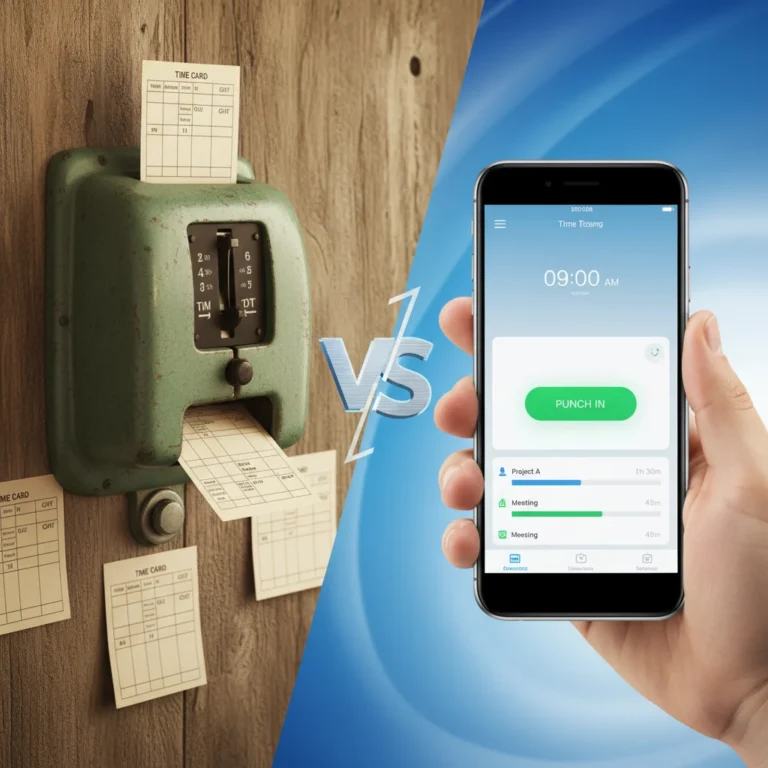
Digital Stamping vs Traditional Tag: SME 2025 Guide
18 March 2026
Invisible margin: how much do micro-delays in the field really cost you
31 March 2026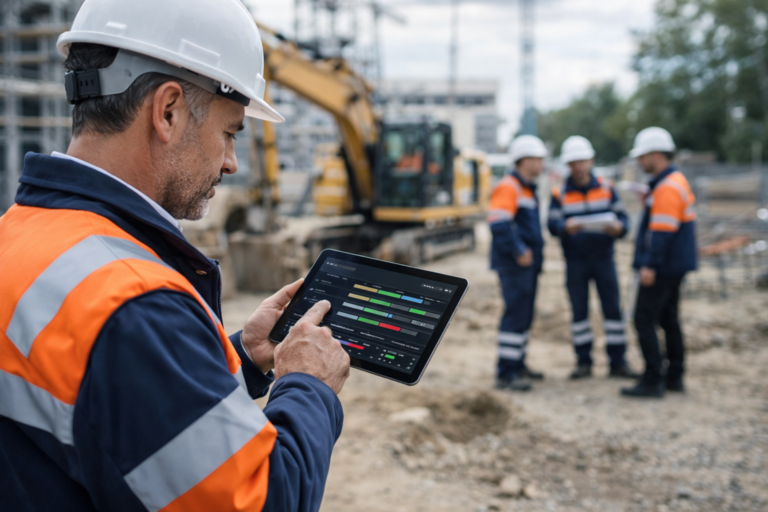
Real-time order control: how to avoid contested reports at the end of the month
2 April 2026![How to choose an attendance recording software for SMEs [2025 Guide]](https://geotapp.com/blog/wp-content/uploads/2025/11/generated-image-2025-11-17-2-768x768.webp)
How to choose an attendance recording software for SMEs [2025 Guide]
18 March 2026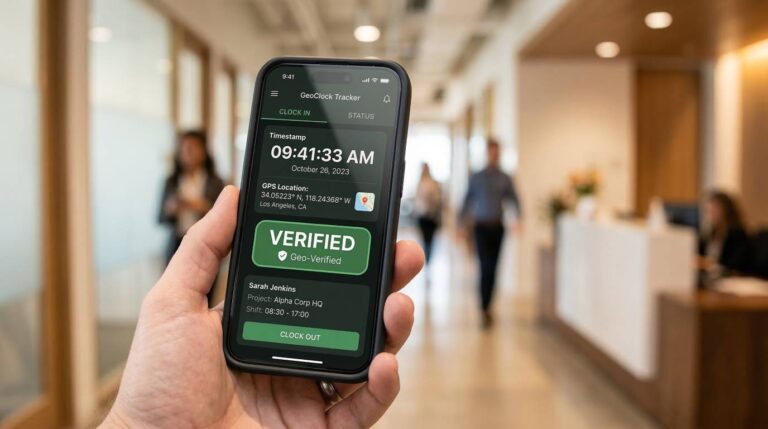
App for Cleaning Companies: Geolocalized Stamping, GDPR and Zero Disputes
18 March 2026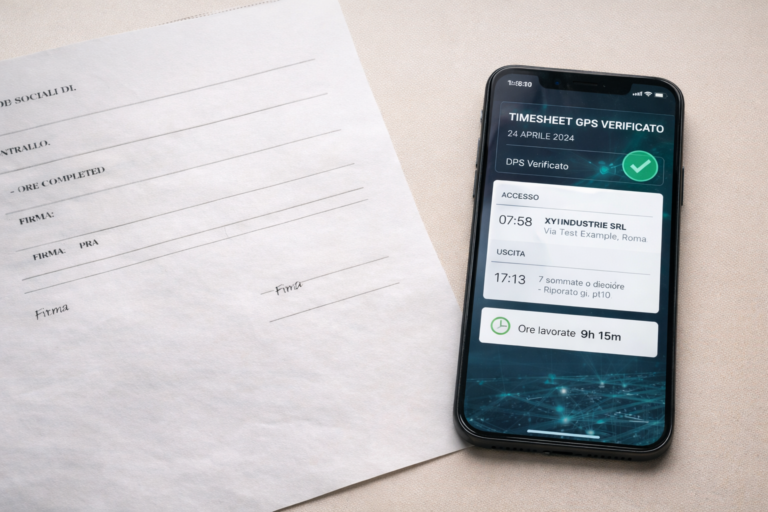
CCNL Multiservices 2026: GPS presences, obligations and risks
2 April 2026