
GPS employee tracking is legal — but only if you follow exactly what GDPR requires in 2026. Those who get it wrong face fines starting at €10,000. This guide explains what you can do, what you cannot, and how to choose a compliant GPS tracking system for your employees without legal risks.
Who this article is for: owners, operations managers and administrative officers at field service companies.
Goal: reduce disputes, recover billable hours and improve operational control without complicating work in the field.
Contenuti
- Is GPS tracking employees legal? Yes — but only if you know exactly what you’re doing.
- The legal framework: what GDPR actually says about workplace GPS
- The 5 most common GDPR violations in field service
- How GeoTapp handles GDPR compliance automatically
- What you must do BEFORE activating GPS on employees
- Labour law considerations: what applies across Europe
- FAQ: the questions we receive every week
- Conclusion: compliance is not bureaucracy, it is mutual protection
- The Line Between Lawful Monitoring and Illegal Surveillance
- How to Structure GDPR Documentation for Geolocation
Is GPS tracking employees legal? Yes — but only if you know exactly what you’re doing.
Every week a field service entrepreneur asks me: “Can I use GPS to monitor where my technicians are without running into trouble with GDPR?”
The answer is yes. But with precise conditions that many companies don’t meet — often out of ignorance, not bad faith.
The legal framework: what GDPR actually says about workplace GPS
The GDPR (EU Regulation 2016/679) does not prohibit GPS tracking of employees. It regulates it. The applicable legal basis in the employment context is the employer’s legitimate interest (Art. 6(1)(f)), subject to a documented balancing of interests.
Three conditions must be met:
- Legitimate and proportionate purpose: tracking serves to document work, not to monitor private life
- Adequate notice: workers know they are tracked, how, for how long and why
- Processing limitation: GPS is active only during working hours
If even one of these conditions is missing, the company is exposed to sanctions.
The 5 most common GDPR violations in field service
| Violation | Typical scenario | Potential fine |
|---|---|---|
| 24/7 tracking | GPS app always on, even off-shift | Up to €20M or 4% of turnover |
| Missing notice | “Everyone knows” with no documented signature | €10M or 2% of turnover |
| Unlimited retention | GPS data stored for years without a policy | €10M or 2% of turnover |
| Unauthorised access | Anyone in the company can see GPS data | Variable |
| Extra-EU transfer | Data on US servers with no safeguards | Significant |
Data protection authorities across Europe have been intensifying controls in the field service sector since 2024. This is no longer a theoretical risk.
How GeoTapp handles GDPR compliance automatically
GeoTapp was designed with GDPR as a non-negotiable requirement:
1. Tracking only during working hours
GPS activates when the technician starts a shift and deactivates when they close it. Outside declared hours, no location data is collected.
2. Notice built into onboarding
At first login, every worker reads and digitally signs the privacy policy on GPS data processing. The signature is timestamped and stored.
3. Configurable retention
The administrator sets the data retention period (e.g. 24 months). At expiry, deletion is automatic.
4. Access to personal data
Each worker can view their own GPS data from the app. Portability and transparency guaranteed.
5. EU servers
All data is stored on European infrastructure (GDPR Art. 44-49 compliant).
“The DPA contacted us for an inspection following a complaint from a former employee. We showed the GeoTapp GDPR panel in 20 minutes: signed notice, data limited to working hours, retention policy, access logs. The inspection closed with no findings.”
— HR Manager, industrial cleaning company, 48 employees
What you must do BEFORE activating GPS on employees
Pre-activation checklist:
- [ ] Data Protection Impact Assessment (DPIA): mandatory if tracking covers more than 10 people systematically
- [ ] GPS-specific notice: a generic privacy notice is not enough — a dedicated document is required
- [ ] Works council consultation (if applicable): some sectors require employee representation agreement for monitoring systems
- [ ] Records of processing activities: update the controller’s register with the new GPS processing
- [ ] DPO appointment (if required): if you process special-category data on a large scale
GeoTapp provides document templates for all these requirements in the Compliance section of the admin panel.
Labour law considerations: what applies across Europe
Beyond GDPR, GPS tracking of employees may also be governed by national labour laws. Across the EU, the key distinction is between:
Work tools (company smartphone used for clock-in): generally do not require prior consultation with employee representatives, but require adequate notice.
Monitoring devices (GPS installed solely for surveillance): may require works council agreement or prior authorisation from a labour authority, depending on the country.
GeoTapp falls into the first category: it is a work tool that also generates location data as an ancillary function of attendance tracking. This is the most favourable framework for companies.
FAQ: the questions we receive every week
“Can I see where my technicians are in real time?”
Yes, if it is stated in the notice and serves to coordinate work. GeoTapp has an optional live map that you can enable or disable.
“Can technicians turn off GPS?”
Yes, outside working hours. During an active shift, location is required for the core function (site clock-in).
“How long can I keep the data?”
GDPR requires the minimisation principle. GeoTapp recommends 24 months for field service; beyond that, a documented justification is needed.
“What if a technician refuses?”
An informed refusal is a worker’s right. But if GPS is an integral part of the company work tool, refusal equals refusal to use the work tool — a contractual matter, not a GDPR one.
Conclusion: compliance is not bureaucracy, it is mutual protection
A GDPR-compliant GPS system protects the company from fines, but also protects workers: their data is secure, used only for declared purposes, and deleted when no longer needed.
Compliance is not an obstacle. With GeoTapp, it is automatic.
The Line Between Lawful Monitoring and Illegal Surveillance
The difference between a legal and an illegal geolocation system is not in the technology — it is in consent and purpose. Data protection authorities have clarified in multiple rulings that employee geolocation is lawful if it is instrumental to a legitimate work purpose (coordinating sites, verifying attendance, ensuring worker safety), if it is proportionate to that purpose, and if employees have been clearly informed and have given consent.
Continuous monitoring of an employee’s movements throughout the entire working day — knowing every five minutes where they are, even between one site and the next — is almost always disproportionate to any reasonable work purpose. GeoTapp was designed to stay on the right side of this line: it records location only at clock-in moments, does not monitor continuously, and data is used exclusively for the purposes declared in the policy.
How to Structure GDPR Documentation for Geolocation
GDPR compliance for employee geolocation requires specific documentation that many SMEs have not yet prepared. You need a dedicated employee privacy notice describing what data is collected, for how long, for what purpose and who has access. You need an appropriate legal basis — typically the company’s legitimate interest for coordination purposes, complemented by explicit consent for geolocation data. You need a risk analysis if the processing is high-risk.
GeoTapp provides ready-to-use templates for all this documentation, adapted to European data protection law and already validated in practice. You do not need to start from scratch and you do not need to pay a legal consultant to build the policy from zero. The system guides you through a configuration that automatically respects the data minimisation thresholds and retention periods required by law.
Keep reading

ICO, Employee GPS Tracking and UK GDPR 2026: What Field Service Businesses Need to Know
13 April 2026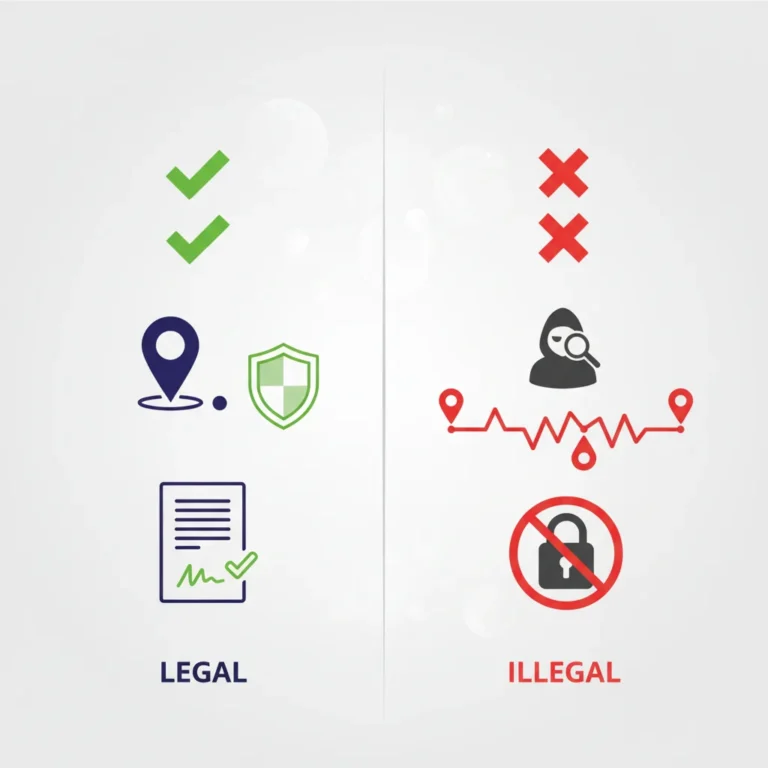
Track Your Field Team Legally: GDPR Compliance Guide
18 March 2026
CCNL Multiservices 2026: Avoid €60K+ compliance risks
2 April 2026
Stop Losing Contracts: GPS-Verified Cleaning Service Evidence
18 March 2026
Digital Stamping vs Paper Cards: Real Costs & ROI
18 March 2026
Choose the Right Attendance Software for Your SME
18 March 2026