
It’s Friday afternoon. Your fitter has just finished the job, put everything back together, said goodbye to the customer, and got back into the van. Great. Then you get a message: “The job wasn’t done properly.” Or worse: “You didn’t even turn up.”
Do you have the photo of Marco on your phone? Perhaps. Is it the right one, taken on site, with the time stamp? Let’s hope so. Do you have the customer’s signature? No, we never get that. So how do you prove that the work was carried out, where, and when?
If you manage a team of installers, electricians, plumbers, systems engineers, maintenance technicians, you already know how this story ends. It ends up being one person’s word against another’s, with the customer refusing to pay, and you having no means to defend yourself.
Run one week of installer jobs with automatic GPS, photo and signature on each visit, and see if any “never arrived” claim still holds.
No credit card, up and running in 2 minutes.
Open your trialThe problem isn’t the quality of the work
Let’s be clear: disputes almost never arise from a job done poorly. They arise from a lack of evidence. The customer forgets, exaggerates, changes their story. Sometimes they’re acting in bad faith, sometimes they’re genuinely convinced they remember things differently. And you’ve got nothing to go on.
The paper worksheet, if there is one, ends up in the van. The photo on WhatsApp has no verifiable GPS metadata. The ‘done!’ message Marco sends you at 4.47 pm isn’t evidence that holds water anywhere. You’re building every day on a fragile foundation, and you don’t realise it until it gives way beneath your feet.
Have you ever found yourself wasting time, hours, not minutes, trying to piece together what happened, who went where, when, and with what result? That is the direct consequence of not having a system.
Why installation companies keep carrying on like this
The reason is simple: so far, it’s worked well enough. Most customers don’t complain, things get sorted out somehow, and there’s never been a problem big enough to justify changing habits. Until the big one comes along.
Then there is a second, more insidious reason: the belief that ‘my lads would never use an app’. That it’s too complicated, that it would slow down the work, that a fifty-year-old plumber doesn’t know what to do with an app on his phone. That was true ten years ago. Today, that’s no longer the case, especially if the app is designed for those working in the field rather than those in the office.
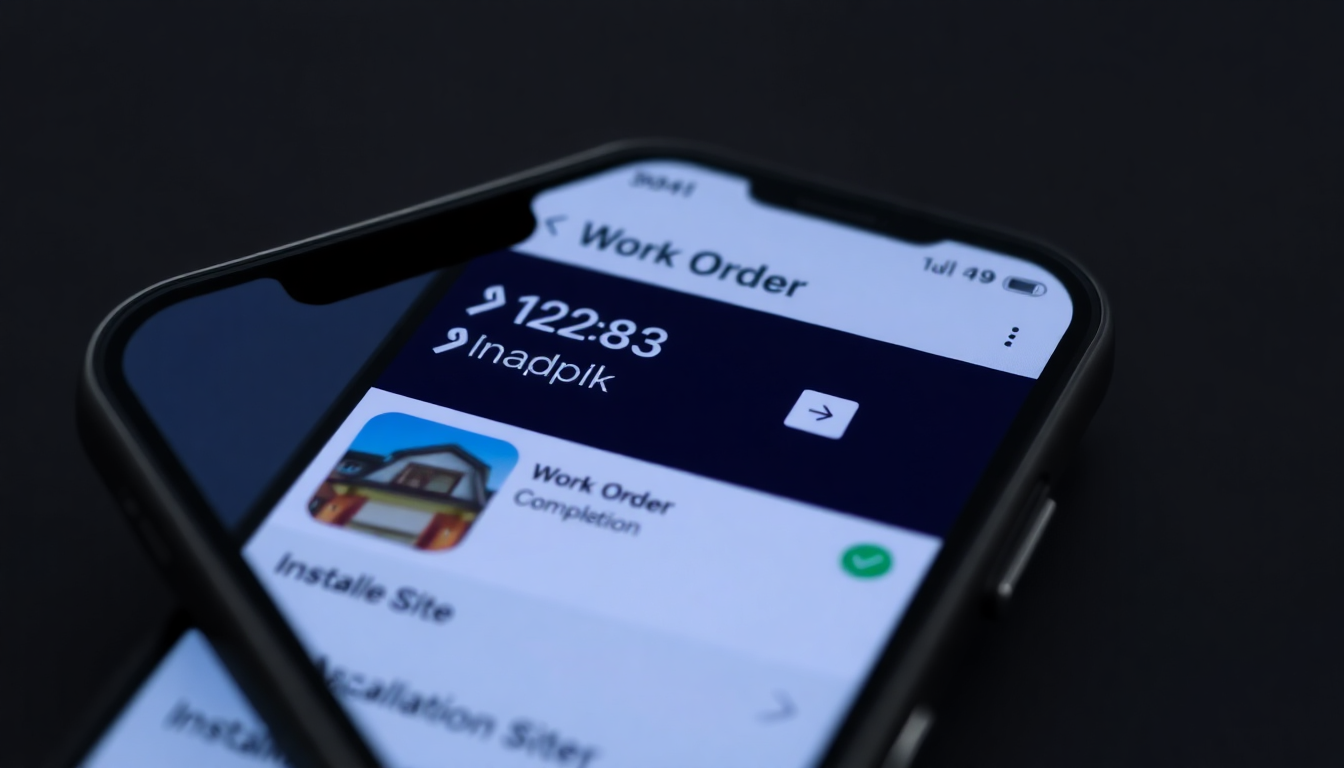
The reality is that there are tools designed precisely for this purpose. Not complex management systems, not software that takes weeks to set up. Apps for installers that let you open and close a job with two taps, automatically geolocate entry and exit from the site, attach photos directly to the job order, and generate a report that the customer can even sign digitally, all without paper, without WhatsApp, without having to remember anything.
What happens when you have no proof
Imagine a real-life scenario. You have three teams out and about in the city, all working on different jobs. A customer calls and says the team arrived two hours late and left the premises dirty. One of your staff replies that this is untrue, that they were there at 9:00, and that they cleaned up before leaving. Who is right?