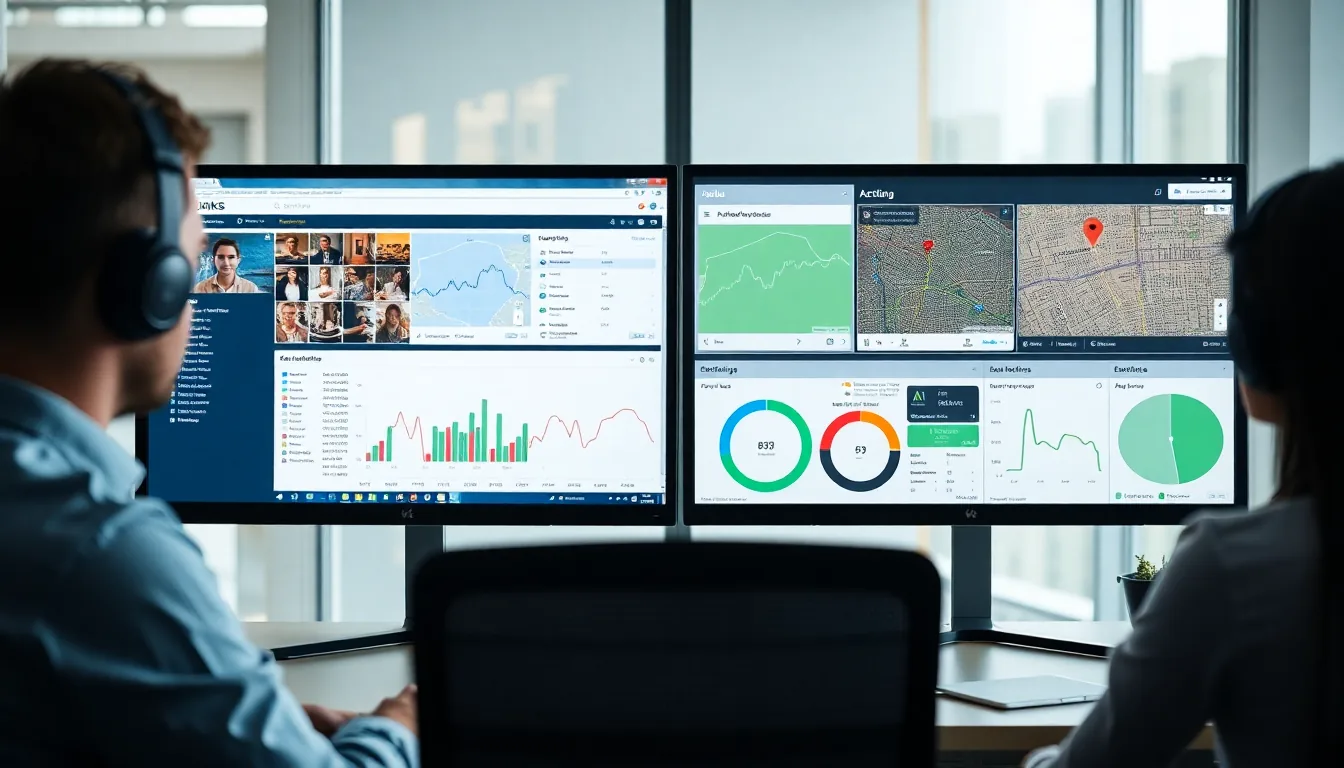
You are looking for an app to monitor what your employees do. Someone tells you to check Hubstaff. You land on their site and you see a promise of total transparency: random employee screenshots, app and website tracking, activity scoring based on mouse and keyboard movements, GPS for field staff, route planning for crew optimisation. It looks like the dream of any manager who does not really know what their team is doing. Then you speak to your employment counsel and they say a sentence that stops you cold: “you cannot do this in the UK, not like this”. That is when you realise that between “I want to know what they do” and “I have the right to know it the way I want” there is a distance UK law measures with concrete sanctions.
Hubstaff is a serious product. They are American, headquartered in Indiana, declare over 95,000 customer businesses, have existed since 2012, and integrate with practically anything. Their problem is not software quality, it is positioning. Hubstaff is an employee monitoring tool born for the United States market, where workplace culture and legal framework allow many practices that in the UK are regulated by UK GDPR, the ICO, the Information Rights Act 2018 and ACAS guidance. Bringing Hubstaff into a UK SME without careful mediation means exposing yourself to concrete legal risks. That is what I want to clarify here.
Full disclosure: I am the founder of GeoTapp, so do not expect a neutral review. What I can promise is that I will not invent anything about Hubstaff (I will only cite official data from their site) and that I will tell you honestly where they do your job better than I do. Above all, I will explain why in many UK contexts they are not the right tool, and why GeoTapp deliberately chose a different path.
If you want to choose between surveillance and certification with your own eyes, open the model I defend and test it on your reality.
No credit card, up and running in 2 minutes.
Open your trialWhat both apps do (apparent overlap)
Hubstaff and GeoTapp are both B2B apps for tracking work hours and employee activity. Both record GPS attendance, manage staff distributed across multiple sites, export payroll reports. Both have mobile apps and a centralised dashboard for management.
The overlap is only apparent. Hubstaff is an employee monitoring product: what the employee does minute by minute, both in the office (screenshots, apps, mouse, keyboard) and out (GPS, routes, geofencing). GeoTapp is a work certification product: what the employee completed at a specific site, in a way the client can verify. Two deeply different product philosophies. One controls, the other documents.
Where Hubstaff is stronger
Hubstaff offers depth of monitoring few competitors match. For anyone managing remote computer-based teams who needs to know what they are working on at every moment, the package is comprehensive: configurable screenshots, visited URLs and apps tracking, activity scoring based on mouse and keyboard movements, time tracking by project and client. For agencies with remote freelancers billing by the hour, or for call centres wanting Taylorist productivity measurement, Hubstaff provides rich data.
On the field service side they have built what you expect: GPS time tracking, geofencing for automatic clock-in/out when the employee enters or leaves an area, route planning to optimise crew runs, payroll integration with multiple currencies (useful for paying global freelancers). Integrations are numerous: ClickUp, Asana, Trello, Jira, Slack, QuickBooks, FreshBooks and more. Through Zapier you reach thousands of other apps.
The product is mature: twelve years of development, declared user base of over ninety-five thousand businesses, stable technical support. For anyone choosing with an eye to global vendor reliability, Hubstaff is a reassuring name.
Where GeoTapp is different (and in some cases better suited to the UK context)
The difference between Hubstaff and GeoTapp is not a feature difference, it is a philosophical one. Hubstaff assumes the employer has the right and need to know what the employee does at every moment of the shift. GeoTapp starts from a different assumption: the employer needs proof the work was completed, not minute-by-minute control of how it was performed. Two different ethical positions, and in the UK they carry different legal consequences.
UK GDPR Article 5 requires processing to be lawful, fair and transparent, and Article 6 requires a documented lawful basis. The Information Commissioner’s Office has published specific guidance on workplace monitoring, requiring proportionality, transparency, and impact assessment for any system that captures personal data beyond what is strictly necessary. Tools that capture random screenshots, monitor every website the employee opens, or track mouse movements exceed proportionality in most cases and have been the subject of ICO enforcement notices in recent years. GeoTapp is designed from the outset to respect this framework: it records only the opening and closing event of the intervention, the GPS position at those two moments, optional photographs of completed work, and produces a sealed report. No screenshots, no mouse tracking, no app monitoring. It is a deliberate design to be UK GDPR compliant without acrobatic configuration.