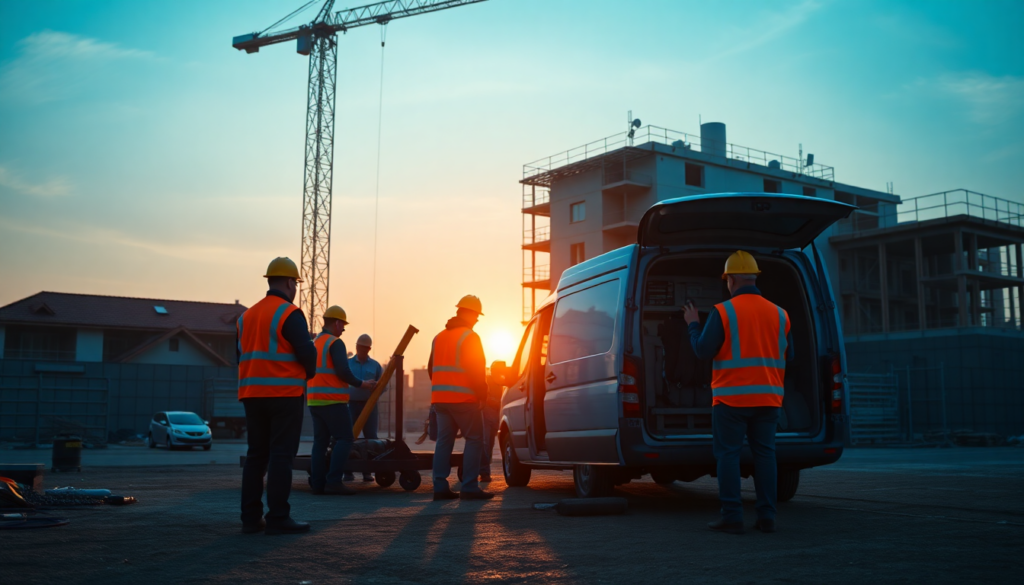
Twenty to five on a July morning, the kettle in the site cabin already hissing, and your foreman is walking the scaffold with a head torch because you moved the pour to five, the forecast says thirty-three by lunchtime and concrete does not wait for anyone. Nobody ordered you to do this. There is no law in Britain that shuts a site when the mercury hits a number, you shifted the whole day to dawn because it was the only sensible thing left to do.
That is the strange position every UK employer sits in this summer: there is no legal maximum working temperature. Not for offices, not for scaffolds, not for the back of a delivery van at two in the afternoon. Plenty of owners read that and breathe out, no threshold, no problem, we carry on. They have it exactly backwards, and the ones who relax are usually the ones who end up explaining themselves later.
Because what fills the gap is your duty of care. Under the Management of Health and Safety at Work Regulations 1999 you must assess every risk to your people’s health, and the Health and Safety Executive treats heat as a hazard like any other, something you identify, measure and control. In June 2026, in the middle of a national heat health alert, the regulator said it plainly: the risks to workers from extreme heat must be properly assessed. A fixed threshold would at least give you a safe harbour, a thermometer to point at. Its absence means the judgement, and the liability that travels with it, never leave your desk.
The law hands you the judgement, and the paperwork that goes with it. Want the hours side to take care of itself?
If you want to see where this is heading, look across the Channel. In Italy, by the summer of 2026 nearly every region had signed ordinances stopping outdoor work between 12:30 and 16:00 on days flagged as high risk on the national Worklimate map run by INAIL and the CNR, and the stop covers building sites, farms, logistics yards and delivery riders. France moved first with a national rule: décret 2025-482, in force since 1 July 2025, ties employer duties directly to Météo-France heat vigilance, so a yellow, orange or red alert now triggers concrete obligations to reorganise the work itself.
Try GeoTapp free for 14 days
No credit card required. Get started in 2 minutes.
Spain has gone furthest on enforcement. Employers there are already obliged to adapt or shorten the working day when the weather service issues an orange or red heat warning, and in mid-June 2026 the labour inspectorate sent more than 113,000 letters to agricultural and construction firms reminding them of exactly that. The letters were described as informative, but the record behind them was not: in the 2025 season alone the same inspectorate carried out more than ten thousand checks on working conditions in the heat and issued fines totalling over one and a half million euros.
None of this binds you in Birmingham or Belfast, at least not yet. But it tells you which way the wind is blowing, and it describes the playbook regulators everywhere now expect to see when the forecast turns red: start at dawn, split the shift around the hottest hours, stop in the middle of the day. Your own risk assessment, the one HSE expects you to act on, will almost certainly say the same. Which quietly creates a second problem, the one nobody writes in the guidance notes.
The shift moved. Can you prove it did?
The moment you move work to five in the morning, or cut it at noon and pick it up again at five in the afternoon, your time records become the whole story. Picture the bad version: a worker collapses on a Thursday at 2pm and the investigation turns on whether he was on site at all, or whether, as you say, the crew had knocked off at half past twelve. A paper timesheet filled in on Friday defends nobody, and a WhatsApp message saying we started early is not a record, it is a claim.
The same logic runs through the quieter cases, the ones that never make the news. An employee disputes his hours at a tribunal, a client asks why a full day was billed on a site that stood empty by one, an insurer wants evidence that the risk assessment was followed rather than filed. Your assessment says work rescheduled to cooler hours. Fine. Show it. What stands up is proof generated automatically at the moment it happens, stamped with the real time and the real place, and impossible to tidy up afterwards.
A record that is already filed by breakfast
This is the job GeoTapp was built for. Your crew clocks in from the phone at the gate, the exact time and location are recorded on the spot, and when someone comes asking, an inspector, a client, a judge, you export the record instead of reconstructing the week from memory. The shift can chase the forecast every single day, the proof follows it without anyone filling anything in on a Friday afternoon.
So before the next amber alert lands, ask yourself one honest question: if someone asked you today at what time your crew actually worked last Thursday, what would you show them? If the answer is a spreadsheet and good faith, open a free trial and put the proof on autopilot. Then run the summer the way the heat demands: in at dawn, out before the worst of it, everything already on the record, and the evening still yours.
Get articles like this in your inbox
Practical insights on GPS tracking, field operations and GDPR. No spam, just useful content.