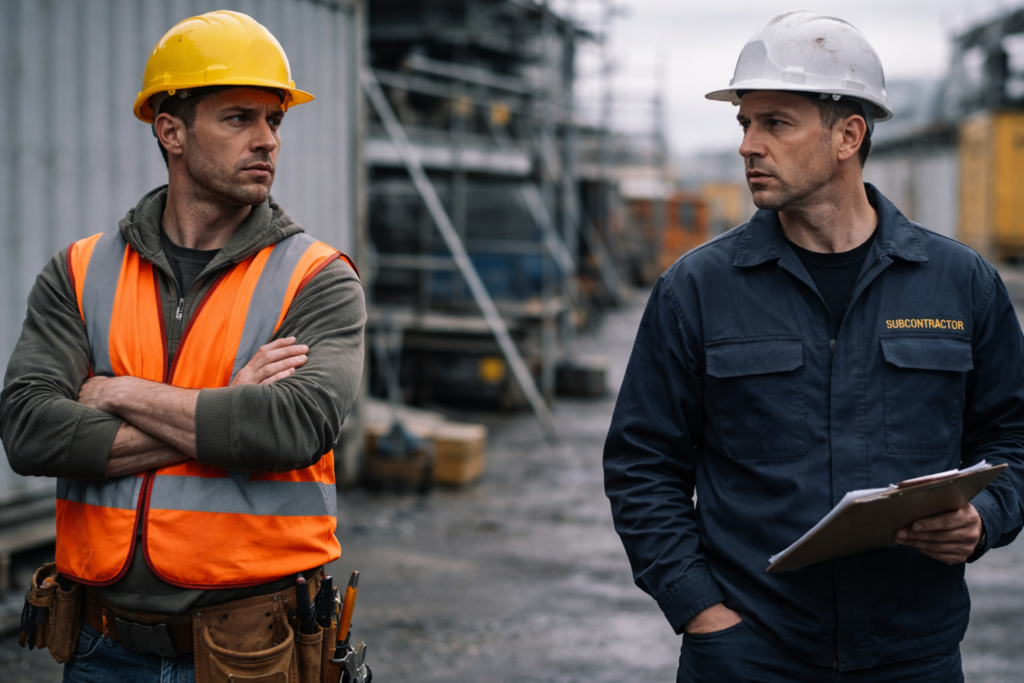
There is a phone call every main contractor knows, and it never comes at a good moment. On the other end is the client, saying that last week’s job does not show up, that the report does not add up, that they would like to understand. You did not carry out that work yourself: you had subcontracted part of it, the way you do with a share of jobs every month. But that distinction, which feels decisive to you, means very little to the client. They signed a contract, and they signed it with you.
Subcontracting, across cleaning and field services, is everywhere. The main contractor wins the work and then hands part of it to third-party firms, because it is efficient, because it is flexible, because often it could not be done any other way. What is less visible, at least until it happens, is where responsibility comes to rest when a link in the chain does not hold. And where it rests is not a question of fairness, it is a question of contract: it climbs back up to whoever signed the main agreement, regardless of who actually held the mop or the spanner.
Documentation is the weak link, and almost nobody guards it
In most subcontracting arrangements, documentation is exactly the point where the chain goes thin. The main contractor keeps a reasonably careful record of its own work, because it knows it is answerable for it, but on the part handed to a third party its visibility is, to put it generously, indirect. The subcontractor produces its own documentation, often informal, often filled in at speed at the end of the day, and passes it up to the main contractor, who files it without looking too closely. It works, in the sense that it works right up until somebody looks closely.
Then a dispute arrives, and somebody does look closely. The sign-in sheet is not signed. The times do not agree with one another. The operative’s location cannot be verified at all. The main contractor, who never touched that job, finds itself answering for evidence it did not produce and never controlled. Anyone who handles commercial disputes in services sees it repeat with an almost tedious regularity: when the subcontractor’s documentation does not stand up, the bill is paid by the firm that signed the contract, even when its own part of the work was handled impeccably.
Try GeoTapp free for 14 days
No credit card required. Get started in 2 minutes.
It is worth being clear about the shape of this, because it surprises people. Whatever the arrangement behind the scenes, the main contractor is answerable to the client for the whole of the performance, the subcontracted part included. The client has a contract with you, not with your subcontractor, so it is you they ask to account for the service, all of it. The sentence “it is not my fault, it is my subcontractor’s fault” carries roughly the procedural weight of a shrug. The client may listen to it, may even nod politely, and will then present the bill to whoever signed.
And without contract terms that pass the documentation duty down to the subcontractor in a binding and, above all, verifiable way, the main contractor is left without a defence worth the name. This is not a detail to tidy up afterwards. It is the structural risk sitting underneath every subcontracted job you take on.
Guarding the chain instead of hoping it holds
The only protection that genuinely works is not a declaration and not one more sign-in sheet, it is structural. The firms that handle subcontracting without losing sleep have adopted a principle as simple as it is radical: the documentation of the job must be generated by the same system for every operative, the in-house ones and the third-party ones alike, whoever employs them. The subcontractor no longer sends a report. It uses the same tool, which produces, automatically, logs to the same standard of verifiability, visible to the main contractor in real time.
The advantage runs both ways, and it holds itself up. The main contractor finally has the evidence for the whole job, including the parts it did not carry out, and can answer a dispute with data instead of good will. And the subcontractor documents more carefully, because it knows its data is being seen as it is produced, not parked in a folder nobody opens until the day of the problem. It is striking how much the accuracy of people improves once they know they are being seen.
Have you ever paid the bill for a dispute over work you had subcontracted out? Tell us in the comments below: it is a situation far more common than anyone living through it cares to admit. And if you manage jobs with subcontractors and want to extend verifiable documentation to third-party operatives too, take a look at how GeoTapp works. Responsibility cannot be delegated. It can only be guarded, with proof.
Get articles like this in your inbox
Practical insights on GPS tracking, field operations and GDPR. No spam, just useful content.