

You run a cleaning company and you send three people to do the post-construction cleanup of a site in Munich. You run an installation business and the crew sets off for France. You run a security firm and your staff cover an event in Spain. In all three cases you want to know where they are, what time they started, that the job got done. Normal. And you take for granted that the rules on how you can track them are the ones you know from home.
They are not. Every European country has its own rules on monitoring workers, and they apply where the work takes place, not where your registered office is. A company based in one country, with a crew on a job in Germany, follows German rules. It sounds like a detail for lawyers, until a complaint or a fine shows up.
Same Europe, different rules
They all start from the GDPR, the European regulation. But then each country adds its own national layer, and these layers vary quite a bit. A few examples of how those national layers differ, on an equal footing. In Italy there is Article 4 of the Workers’ Statute, which requires a union agreement or authorization from the Labour Inspectorate before installing tools that can lead to remote monitoring. In Germany, before you even switch the system on, you need an agreement with the works council (the Betriebsrat): without it, you do not even get started, and the competent authority is the data-protection regulator of the Land where the company has its seat. In France the CNIL is in charge, working on accountability rather than prior authorization, demanding proportionality and prior notice. In Spain the AEPD applies the LOPDGDD, with its Article 90 dedicated specifically to geolocation.
And the penalties are not the same. In some countries a violation is worth a few thousand euros, in others it climbs fast. In Spain a company was fined for geolocating its employees without a proper legal basis and notice. The range, between the minor case and the serious one, goes from a few thousand euros up to figures that scare anyone who manages field operations.
The problem, until today, is that nowhere could you find all of this laid out in order, comparable, and above all verified at the source. You search on Google and you get a thousand pages: one per law, one per country, often outdated, sometimes badly translated. For anyone sending crews around Europe it is a maze. So we built what was missing, and we left it free.
Three tools, one single question: what do I really need, where I work
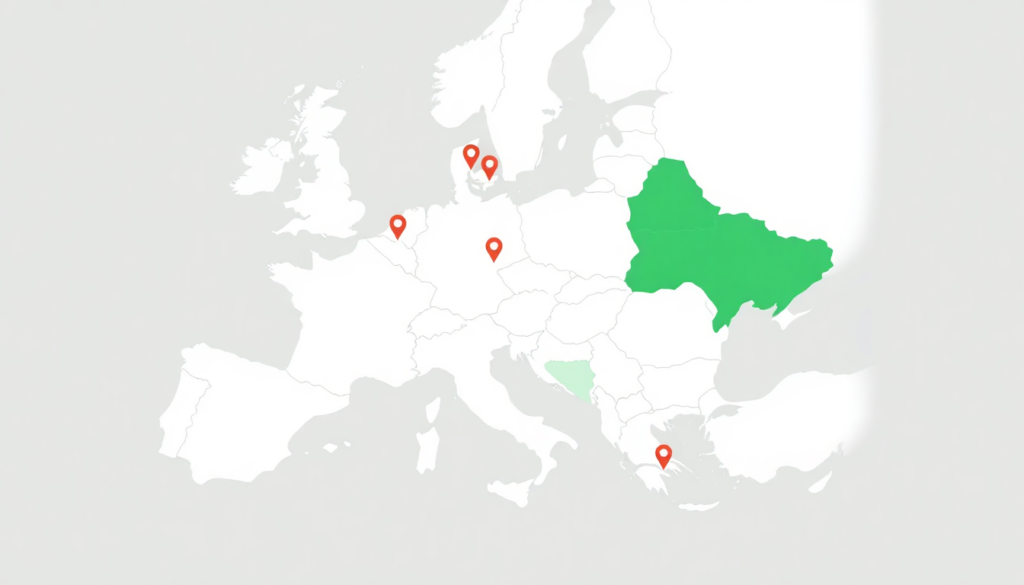
The first is the GPS on workers in the EU guide. You pick the country and you get the complete dossier: what you need to be compliant, with the distinction between what is mandatory, what depends on the case and what you do not need; the step-by-step procedure; who to turn to, with the real contacts of the competent authority; the notice template to download; the maximum penalty with a real case cited; and the primary sources, so you can check for yourself. Thirty-nine European countries, each one checked by hand, not generated at random. If you send a crew to Romania or Norway, in two minutes you know what to prepare before you leave.