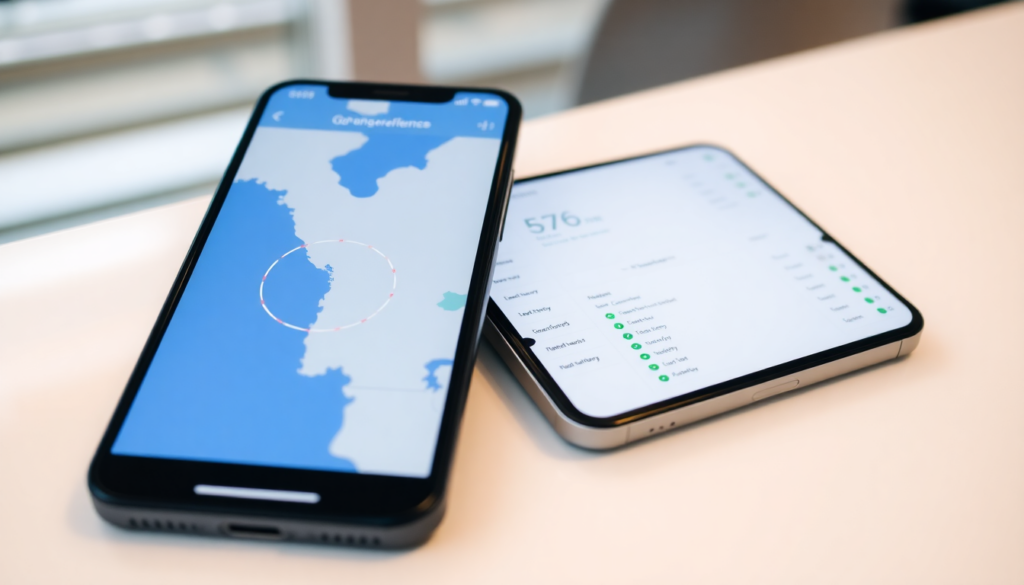
You know that moment when the time tracking app salesman tells you “don’t worry, it has geofencing”? He shows you the map, the little circle around the job site; explains that your operator can only clock in when they’re inside that perimeter. It looks perfect; it looks secure, the problem is that it isn’t.
Geofencing works like this: you set an area on the map; when your operator clocks in the app checks whether the coordinates fall inside that circle. So far so good. In practice geofencing has a fundamental flaw: it only checks whether the coordinates are inside the perimeter, not whether the coordinates are real. A smartphone’s GPS position can be spoofed with a free app in thirty seconds. The operator sets the coordinates; the phone reports being on site; the geofence confirms, everyone’s happy except the operator is actually at home five kilometres away.
Anti-spoofing GPS is something completely different. Instead of just checking “where the phone says it is” it verifies “is the phone really where it says it is”; it cross-references multiple signals simultaneously. If the GPS has been manipulated the anti-spoofing detects it.
If your provider only checks whether the coordinates are inside the perimeter, fourteen days on an anti-spoofing clock-in show what verified position actually means.
No credit card, up and running in 2 minutes.
Open your trialThe point isn’t whether your operators would cheat, most are honest. The point is what happens when your client asks “how can you be sure?” If your answer is “we have geofencing” you’re saying your system can be bypassed with a free app. If your answer is “we have anti-spoofing GPS with cryptographically sealed photos and verifiable reports” you’re saying your evidence is mathematically unfalsifiable. That difference isn’t technical, it’s commercial.
Even if GPS were always correct the position alone proves nothing: it proves the phone was there, not that the work was done. That’s why you need photos sealed with a cryptographic hash chain at the moment of capture. Any modification breaks the seal. It’s not trust: it’s mathematics.