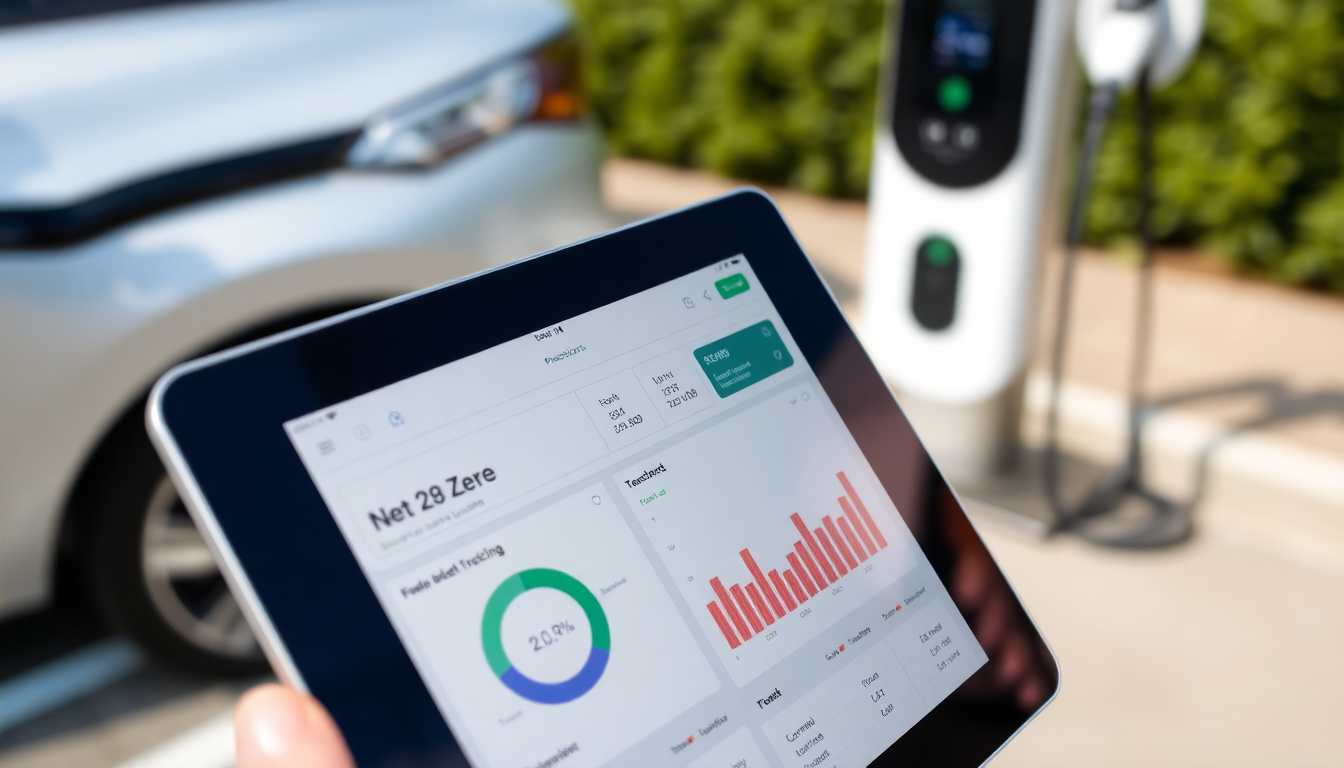
Your biggest client, a national facilities management group, has just added a new clause to their service agreement. Starting Q3 2026, all subcontractors must provide quarterly Scope 1 emissions data for vehicles used on their contracts. You have fourteen vans on the road every day. You know how much diesel you buy. You have no idea how many kilometres each van actually travels, which routes are efficient and which are wasteful, or what your carbon footprint per contract actually looks like. Net Zero fleet GPS data solves reporting.
Welcome to the new reality of UK business. The Streamlined Energy and Carbon Reporting (SECR) framework already requires large companies to report emissions. But the pressure is cascading downstream, through procurement requirements, contract clauses and investor expectations, until it reaches every subcontractor and supplier in the chain. If you run a fleet, you will be asked for your emissions data. The only question is whether you’ll have it ready or scramble to produce it.
The irony is that the hardest part of carbon reporting for fleet operators, accurate mileage data, is already solved if you use GPS tracking. Every clock-in, every clock-out, every journey between sites is logged with coordinates and timestamps. From coordinates to kilometres is simple maths. From kilometres to CO2 is a published conversion factor. The data you already have for time tracking is the same data your carbon report needs.
If the next procurement tender will ask for emissions data, fourteen days on a GPS that already records mileage hand the answer over for free.
No credit card, up and running in 2 minutes.
Open your trialNet Zero fleet GPS: data to carbon
Scope 1 emissions from vehicles are calculated using a straightforward formula: kilometres driven multiplied by the emission factor for that vehicle type. DEFRA publishes conversion factors annually, for a medium diesel van in 2026, it’s approximately 0.24 kg CO2e per kilometre. If your fourteen vans each average 120 km per day over 230 working days, that’s 386,400 km per year, producing approximately 92.7 tonnes of CO2 equivalent. That’s your Scope 1 fleet number, and with GPS data, you can calculate it to the kilometre rather than estimating from fuel receipts.
But accuracy isn’t the only benefit. GPS mileage data also reveals optimisation opportunities. When you can see that Van 7 consistently drives 30% more kilometres than Van 3 to serve a similar number of clients, you’ve found a routing problem worth fixing. A 10% reduction in unnecessary mileage across fourteen vans saves roughly 38,640 km per year, 9.3 tonnes of CO2 and approximately £6,200 in diesel costs. The carbon report pays for itself.