An SLA is a contract, and contracts are upheld through evidence
In the maintenance sector – covering plant, lifts, air conditioning, data networks and electrical systems – Service Level Agreements form the backbone of every contract. They define response times, resolution times, the frequency of preventative maintenance and escalation procedures. They are detailed, binding and, in most cases, provide for automatic penalties in the event of non-compliance.
The problem is that many maintenance companies sign ambitious SLAs without having the systems in place to demonstrate compliance. The call-out arrives, the technician carries out the work, and the problem is resolved. But the customer claims that the agreed response time was not met. Who is right? In the absence of verifiable logs, the answer depends on who has the best lawyer.
The service call log: the only evidence that counts
In a dispute over an SLA, there are three critical moments that must be documented beyond reproach: the moment the customer reports the problem, the moment the technician takes charge of the call-out, and the moment the call-out is closed with the customer’s confirmation. These three timestamps, if generated by a third-party system rather than by the company itself, constitute proof of whether or not the SLA has been met.
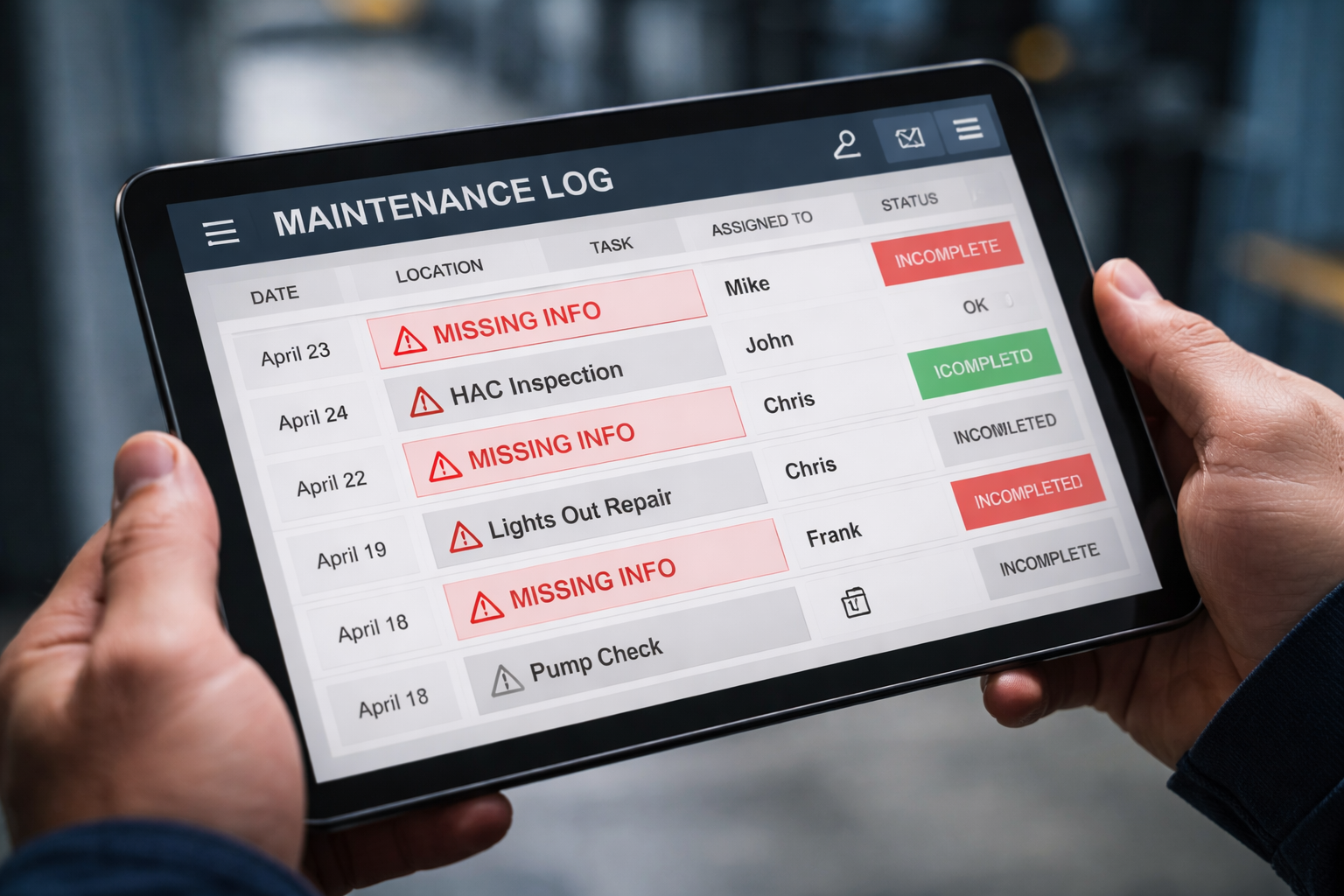
In the reality of many maintenance SMEs, these three moments are recorded using different and incompatible tools: the customer sends an email, the technician replies on WhatsApp, and the completion of the job is noted on a piece of paper that ends up in a filing cabinet. Reconstructing the timeline weeks later, in the event of a dispute, is an almost impossible task.
A survey conducted on a sample of 60 Italian maintenance companies found that 68% do not have an integrated system for managing and documenting SLAs. Most use email, Excel spreadsheets or, at best, management software not specifically designed for managing service records.
The cost of undocumented SLA penalties
SLA penalties in the maintenance sector are often calculated as a percentage of the monthly fee for each hour of delay beyond the contractually defined limits. In a contract worth €10,000 per month with penalties of 2% per hour of delay beyond 4 hours, every service call that is not properly documented potentially carries a risk of €200 per hour. A dispute over three contested service calls in a month can result in penalties running into thousands of euros, even if the technicians were on time.
The paradox is that these penalties are often accepted by the company not because the SLA has not been met, but because it is unable to prove it. It is a bureaucratic capitulation in the face of evidence that does not exist, not a defeat on the ground.