It’s 7.10 pm on a Thursday in October. Marco, your most senior technician, has just returned to the workshop after a day of six call-outs between Brescia and Manerbio. He pulls three crumpled paper reports out of his overalls pocket, places two on the counter and says to you, “I spilled coffee on the third one this morning; I tried to wipe it off but you can’t read the signature anymore. I’ll redo it from memory tomorrow, shall I?” You look at the two surviving reports, and the only thing legible on both is the customer’s name; everything else is a jumble of approximate times, material codes written in cursive, and a signature scrawled on the bonnet of the van that could belong to anyone. Three out of six jobs started at 7.30 am; the other three began in the afternoon. Marco can’t remember exactly what time he left the house in Manerbio. You don’t know whether to bill for two hours or three, and if you bill for three, you risk a phone call disputing the charge.
A week later, whilst the admin department is preparing the month’s invoices, you discover something even more distressing. Luigi, the junior technician you hired in September, had ‘forgotten to fill in’ three job reports over two months. Three actual jobs, materials taken from the warehouse, hours worked, satisfied customers – and no paperwork to invoice them. Reconstructing them now means calling the customers, reminding them of the price agreed verbally, and hoping they’ll pay an invoice for a job done sixty days ago. Two out of three pay only after some persuasion. The third says, “Ah, but I thought you’d done that job under warranty.” Between lost, illegible and forgotten job reports, you’ve just lost nearly €1,400. It’s like this every month.
This scenario is the daily reality for any heating, plumbing or electrical installation company with two, five or fifteen technicians in the field. The paper report is an 80-year-old technology struggling to survive in a trade where the technician has dirty hands, a hot van and a customer in a hurry. It’s not a question of Marco or Luigi being dishonest: it’s simply that the tool is wrong. You need a job report app for field technicians that does the work for them, not adds another task to their load.
If Marco and Luigi know how to carry out the installation but not how to fill in the paperwork, two weeks of digital reports will tell you whether the leak has been fixed.
No credit card required; up and running in 2 minutes.
Take a look at the sectorWhy the paper report no longer works for the trade
The problem isn’t the paper itself. It’s the fact that the paper report concentrates the administrative workload at the wrong time – at the end of the day, when the technician is tired, hungry and wants to go home – and leaves its completion to someone who’s thinking about everything except administrative accuracy. When Marco unloads the van at 7.00 pm, piecing together the exact times of six jobs becomes an exercise in generous estimation. And every approximation is a crack: in invoicing, in the event of a dispute, or in the event of an inspection by the Labour Inspectorate, which requires traceability of the movements of mobile staff.
Then there’s the structural problem of invisibility. On the paper report, you can’t see the actual arrival time, the address details, or the condition of the site before and after the job. You see a handwritten line saying ‘boiler replacement, 2h30, OK’. That ‘OK’ is all there is. If the customer calls three days later saying the boiler is leaking water, you have no way of reconstructing how you left the system on Thursday at 17:42. It’s just Marco’s word against the customer’s, and under the Consumer Code, the burden of proof for proper fulfilment lies with the professional – that is, with you.
Add to that the increasing number of vans. When you have two technicians, you might just manage to keep things organised. When you go up to five, seven, ten, every morning is a logistical nightmare. Who’s going where? Marco’s already halfway to Brescia, but the customer in Lonato calls and says the leak is serious – he needs to be redirected. You have to ring Marco, find out where he really is, divert him, and notify the customer in Brescia. The paper report tells you nothing about any of this. You only realise the gaps in the evening, when half the day has already been wasted.
What a job-report app truly designed for the field needs to do
The first thing – and this is non-negotiable – is that it must work offline. Your technician might be in a basement pub, a plant room in an industrial warehouse, or the space under the stairs in a 1960s block of flats. There’s no signal there. An app that requires a constant connection is unusable, because a technician will never use an app that causes them to lose their work the moment they go offline. The app must collect everything locally – clock-in, photos, signatures, materials – and synchronise when they return to an area with coverage, without the technician having to think about it. If it only works online, it doesn’t work.
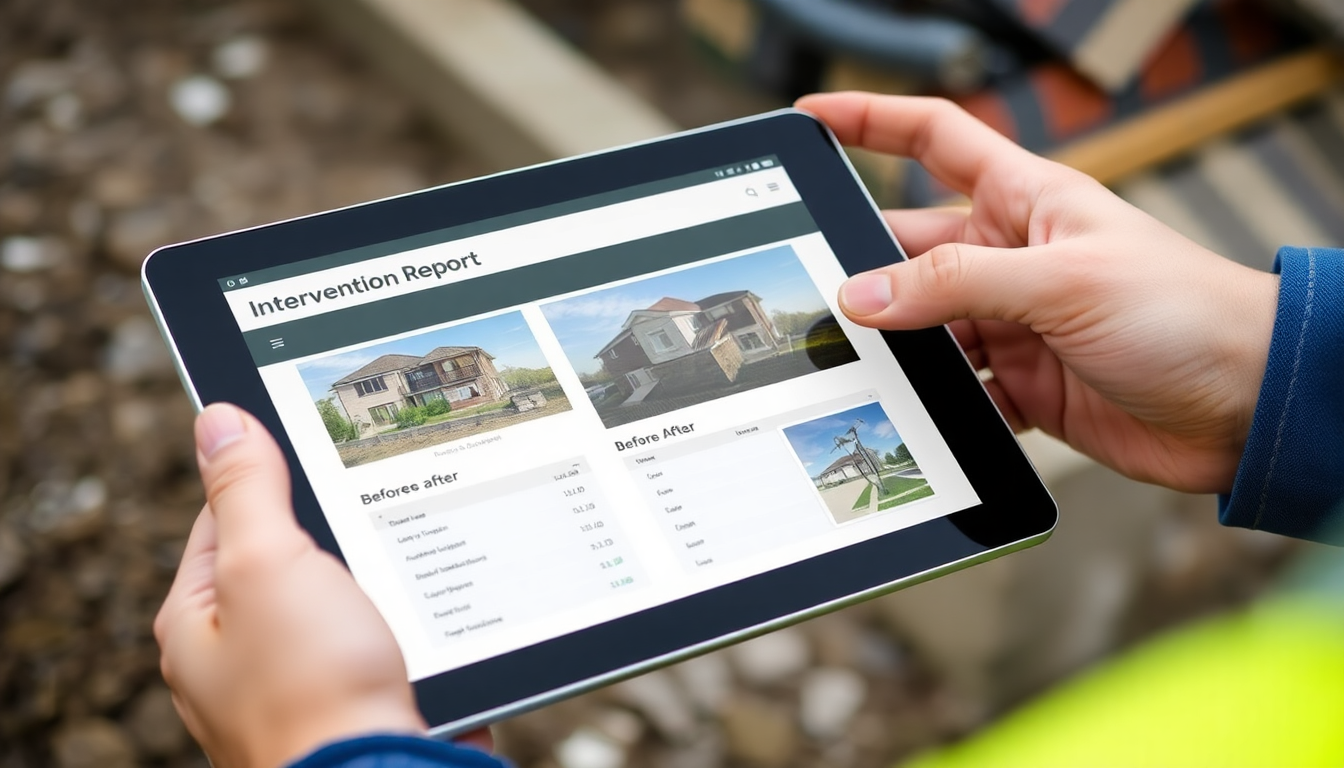
The second requirement is the ‘before’ and ‘after’ photos, taken from within the app, with timestamps and GPS coordinates embedded in the metadata and visible on screen. Not a generic photo taken with the smartphone’s camera roll and sent via WhatsApp – that has no evidential value and gets lost amongst the technician’s grandchildren’s chats. A contextual photo, linked to the specific job, archived in the digital file for that site. The old boiler dismantled. The new one installed. The pressure gauge at 1.2 bar. The condensate drain connected. The electrical panel before and after tidying up. What the technician’s eye sees, the app captures so that anyone – an expert, a consultant, the justice of the peace, or a complaining customer – can see it even two years later.
The third feature is GPS tracking plus a timestamp for every stage of the job: arrival, start of work, any documentable breaks, end of work, departure. This is not continuous tracking that makes the technician feel monitored like an Amazon parcel; that is invasive and demotivating, and contrary to the spirit of Article 4 of the reformed Workers’ Statute. A tap by the technician at specific points, certifying to the millisecond where and when an event took place. This is the difference between spying and documentation, and it is a distinction that Confartigianato and CNA have always clearly explained in the information templates they make available to their member companies.
The fourth is the customer’s digital signature on the service report, captured on the technician’s tablet or smartphone, including a description of what was done, the materials used, the hours worked and any notes on pre-existing faults. This is the document the customer sees before signing. Not a pre-printed carbon copy form pulled from a pocket: a clean screen, featuring your company’s logo, legible and complete. The customer signs and, in the very same second, receives the PDF via email. No more ‘I didn’t know what I was signing’ three days later.