It’s 6.30 pm on a Thursday. You’ve just finished a new-build site where your team has been laying cables for two weeks. The client calls you: “We agreed on those light fittings in the living room on 4 May, didn’t we? Because now the site manager says they weren’t in the specifications.” You know full well they were. They asked you on site, you said yes, you told the lads to fit them. But how can you prove it now?
You open WhatsApp, search for the conversation from three weeks ago, and scroll through three hundred messages between yourself, the client’s surveyor and the foreman. You find a 23-second voice note where you seem to say, “OK, go ahead and do them.” It’s not clear which light fittings you’re talking about. You send screenshots; he replies, “I don’t understand what you’re referring to.” You send the other quotes; he says he didn’t sign that one. A thousand euros vanish in half an hour.
This is a typical day for a self-employed electrician in 2026. The problem isn’t the quality of the work: you’ve done the job. The problem is that you can’t prove it. And without proof, you lose out. On a €30,000 job, you lose €1,000; on ten jobs a year, you lose €10,000. It’s not just an app problem. It’s become a balance-sheet problem.
If a forgotten quote is worth a thousand euros for half an hour’s phone call, two weeks of sealed evidence changes the outcome.
No credit card required; up and running in 2 minutes.
Take a look at the sectorWhat an electrician is really looking for in an app, in 2026
They’re looking for three things, but rarely say so openly. The first is to avoid arguments with the client at the end of a job. The second is knowing where the lads are halfway through the day without having to ring them up one by one. The third is finalising the additional quote on the spot, whilst the client is still in the right frame of mind to sign. Everything else – invoices, work sheets, attendance records – follows on from that.
A generic time-tracking app doesn’t solve any of this. It tells you that a worker clocked in at 7.48 am, but it doesn’t tell you that at 11.20 am he replaced a switchboard that wasn’t in the quote because the client asked for it on site. When a dispute arises, you’ve got a time stamp. You need evidence. They’re two different things.
The four features you must have
GPS check-ins at the actual site. Not on a generic map of the local area, but at the exact coordinates of the street address where the team is working. If tomorrow you need to prove that Marco was at 14 Via Garibaldi from 8 am to 5 pm, and not at 41 Via Garibaldi three kilometres away where you had another site, you need coordinates verified by the phone’s operating system, not entered manually. The phone’s GPS knows this; the app simply needs to record it with a timestamp that cannot be altered afterwards.
Photos of the work completed, cryptographically sealed. The foreman takes three photos at the end of the job: the finished panel, the labels, and certification of the installed product. Those photos must be uploaded immediately to a central server with a cryptographic hash; they must not be left on the phone. If the phone falls into concrete tomorrow, the photos will still be there. If the client says, ‘You didn’t take this photo’, the cryptographic seal proves that it was generated at that moment, on that site, by that phone.
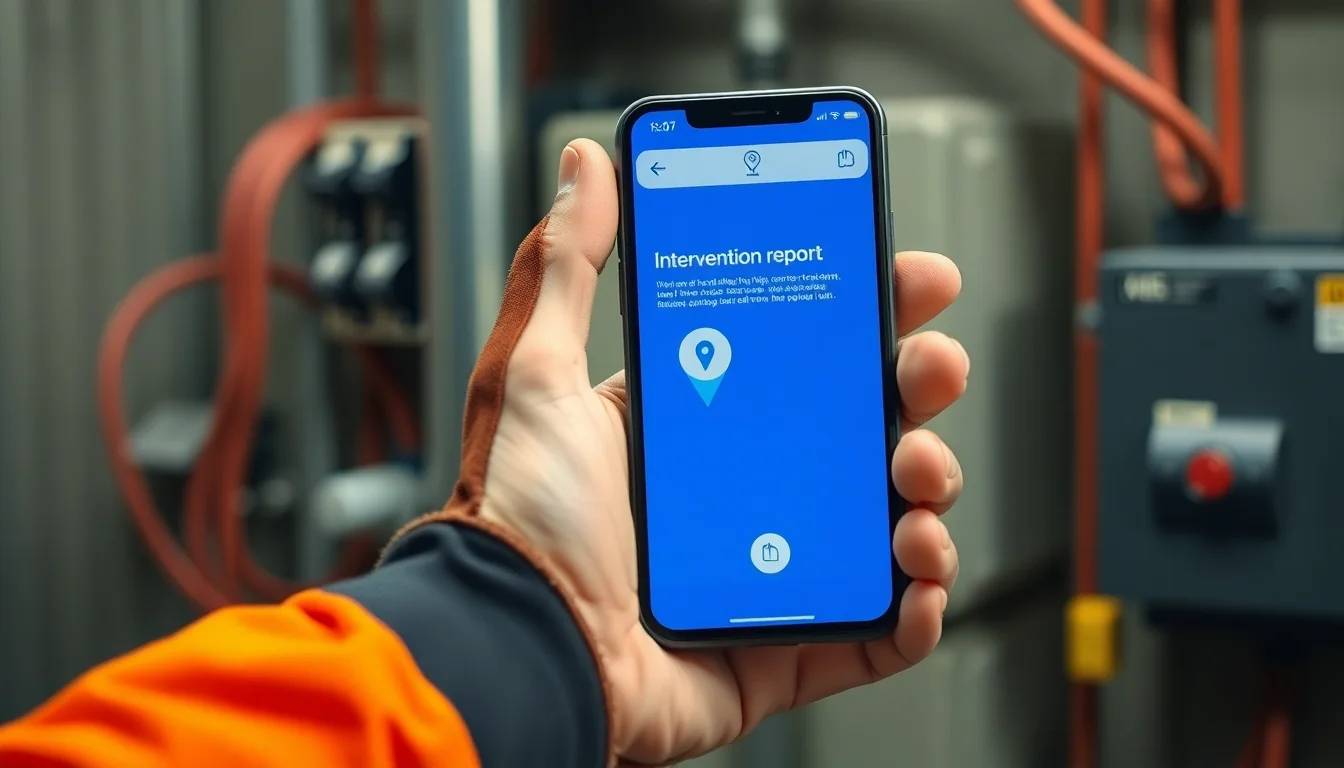
Report sent to the client at the end of the job. The foreman presses a button and an email is sent to the client containing the full package: start and finish times, verified GPS coordinates of the site, photos of the work carried out, and any additional items agreed on site. The client has the official document in their hands ten minutes after the team has left the site, not three weeks later, when nobody can remember anything anymore. In the vast majority of cases, they do not dispute anything: seeing the structured documentation with timestamps and GPS coordinates convinces them that there is no point in trying.