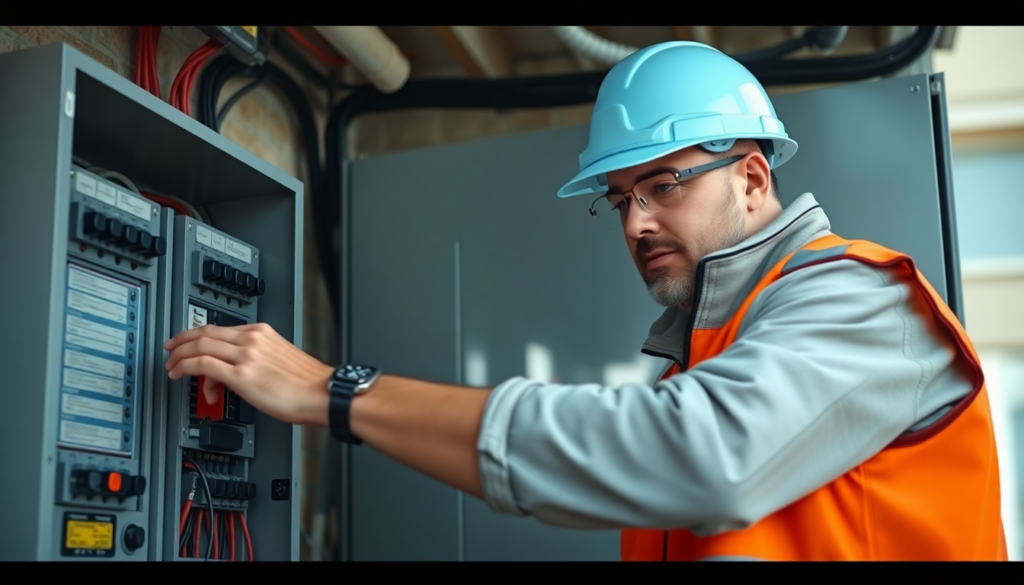
It’s 6.40 pm on a Thursday in March. You’ve just finished refurbishing an electrical distribution board in a detached house in Carpi: three and a half hours spent dismantling a 1990s distribution board with blown circuit breakers, replacing the residual current device, labelling the circuits, checking earth continuity, and rewiring everything. The customer is satisfied; he offers you a coffee and signs the paper service report you’ve filled in by hand on the bonnet of the van – arrival time, departure time, materials, and a description of the work. You tear off the yellow copy for him, keep the white one for yourself, and slip it into today’s folder along with the other four job sheets from the day. You get into the van, ring your wife to say you’re on your way home, and switch on the heating because it’s six degrees outside. The work order for the client in Carpi is underneath the one for the block of flats in Modena where you were after lunch. Tomorrow morning, the folder will end up on your office desk along with the work orders from the other two electricians. On Monday, the secretary will issue the invoice. Perhaps.
Three weeks later, the phone call comes through. It’s the customer from Carpi. He says the invoice for six hundred and eighty euros you sent him is too high, because he remembered the job taking two hours, not three and a half, and that the materials were already in his home, not brought by you. You go to look for the work order. It’s not there. Or rather, there is a work order from Carpi, but it’s for a different job from six months earlier, because someone put the March folder in the wrong filing cabinet. You open WhatsApp to look for photos from that day: you’d taken a photo of the old switchboard before starting the work, but it’s buried amongst two hundred photos of various jobs, with no legible date and no reference to the client. You do have the declaration of conformity under Ministerial Decree 37/2008 that you handed over to him at the end of the work, yes, but that only proves that you declared it to be compliant: it doesn’t prove how many hours you spent on it, it doesn’t prove that you supplied the materials yourself, and it doesn’t prove the condition of the painting before the work began. The client is disputing the work. You’re in a tight spot. You’ll lose three hundred euros of your actual profit margin on that job as a discount, because you have no evidence and you don’t want to take them to court over two hundred euros in disputed fees.
This is everyday life for electricians in Italy running small businesses with two, three or eight staff. The paper delivery note is a seventy-year-old standard that endures because it’s simple, because it works – as long as it works. When it stops working, it does so in ways that cost you real money: disputes lost due to lack of evidence, invoices issued three weeks late because the delivery note has gone missing, declarations of conformity that the owner needs six months later when selling their house and which you can no longer find. The digital report isn’t just a fad: it’s the technical and legal solution to a problem that the paper delivery note can no longer handle on its own.
If the paper delivery note goes missing three weeks before the invoice is due, two weeks’ worth of digital reports will tell you whether the payment will come through.
No credit card required; up and running in 2 minutes.
See the sectorWhat a digital report from an electrician really needs to include
A generic digital work report – the sort sold by apps for fifteen euros a month, designed for any kind of technician – isn’t enough for those who install electrical systems. An electrician’s work has specific requirements that a generic work order doesn’t cover, and which a proper digital work report must be able to handle right from the very first job. The first is a photo of the switchboard or installation before and after the work, geo-timestamped. Not just any old photo saved in your gallery: a photo that the system automatically links to the job, with GPS coordinates of the house or site, a certified time stamp, and a ‘before and after’ sequence visible at a glance. When the customer raises a complaint three weeks later, you open the report and see the old switchboard from the 1990s with its blown fuses, and the new switchboard labelled circuit by circuit, photographed eight minutes apart at the same address. The complaint is settled there and then.
The second is the declaration of conformity pursuant to Ministerial Decree 37/2008, generated or attached directly to the report, with the relevant CEI 64-8 standards specified for the type of installation (domestic, commercial, industrial), the details of the technical manager, and the Chamber of Commerce registration details. Today, many electricians fill it in by hand on paper forms, photocopy it, give a copy to the customer and keep one in a physical archive. Five years’ time, that customer sells their house and the solicitor asks for the declaration: you have a paper archive of seven thousand files and searching for that one takes half a day’s work. On the digital report, the declaration is linked to the customer’s details, the date and the address, and can be retrieved with just three clicks.
The third is the structured materials list, not a free-text field. When you install an ABB 4P 40A 30mA residual current device, three 16-amp circuit breakers and ten metres of FG16OM16 5G6 cable, the digital report must allow you to select them from a pre-loaded catalogue (your stock), rather than typing them in manually into a free-text field. This serves three purposes: to update the stock records in real time, to calculate the exact cost of materials for that job, and to produce an invoice that the customer cannot dispute because every item is coded and quantified. The fourth is the customer’s signature directly on the tablet or smartphone, with explicit acceptance of the work carried out and any declaration of conformity; this digital signature serves as evidence in the event of a dispute and is archived alongside the rest of the report as part of the evidential record.
Ministerial Decree 37/2008, CEI 64-8 and the archive that will save you in five years’ time
Italian electricians operate under regulations which, on paper, are crystal clear: Ministerial Decree 37/2008 governs the installation of electrical systems within buildings; it imposes a requirement for a design plan for systems exceeding certain thresholds; it provides for the issue of a declaration of conformity upon completion of the work by an authorised contractor; and it requires the retention of documentation for the entire lifetime of the system. CEI 64-8 sets out the technical requirements for good practice in electrical installations with a nominal voltage not exceeding 1000 V AC. The professional responsibility of Italian electricians is based on these two standards. In practice, however, day-to-day implementation is often haphazard: declarations of conformity completed at the end of the day whilst tired, mandatory attachments forgotten, single-line diagrams drawn by hand on paper and then lost.
In recent years, Confartigianato Elettrici and CNA Installazione Impianti have published practical guides on digitising the electrician’s workflow, because they know that the biggest problem is not a lack of work: it is the absence of structured documentation which, at the first inspection by a local health authority (ASL) during a routine check, or at the first dispute before the justice of the peace, exposes the electrician to fines or losing the case. The digital report does not replace the declaration of conformity: it supplements it, links it to photographic evidence of the work carried out, connects it to the customer’s details, and makes it searchable by address, date or type of installation. In five years’ time, when the solicitor calls, you’ll have the answer in thirty seconds rather than three hours.
There is another aspect that Italian electricians underestimate: the traceability of the work for tax relief purposes. Private customers carrying out renovations using the Superbonus, Ecobonus or Renovation Bonus need precise documentation for ENEA and for their tax returns. A generic paper invoice is rarely sufficient. A digital report with a structured description of the work, coded materials, before-and-after photos and an attached declaration of conformity is exactly what the client’s accountant is looking for. Consequently, it also becomes a reason why the client chooses you over a competitor who only provides a paper invoice.