Who this article is for: business owners, operations managers and administrative managers at field service companies.
Objective: to reduce disputes, recover billable hours and improve operational control without complicating field work.
→ Book a GeoTapp demo
Set up a compliant clock-in that matches the new Multiservizi obligations on a real shift, and see if the admin really drops by Friday.
No credit card, up and running in 2 minutes.
Open your trial
Multiservizi National Collective Agreement 2026: the GPS timesheet is no longer optional
The update to the Multiservices National Collective Labour Agreement and the circulars issued by the National Labour Inspectorate over the last 18 months have redefined the obligations of cleaning, security, maintenance and facility management companies regarding attendance tracking.
The result? Many SMEs in the sector are technically non-compliant without realising it.
What does the current regulatory framework say?
The starting point is Legislative Decree 66/2003 (implementing the EU Working Time Directive), which requires employers to keep records of the actual working hours for each employee.
In the multi-service sector, this is combined with:
- Multiservices National Collective Labour Agreement: obligation to record attendance for each individual workplace
- INL Circular 2023: clarifications on the documentation requirement for workers at multiple sites
- Transparency Decree (Legislative Decree 104/2022): obligation to inform workers about monitoring systems
The critical point for field service: if an operator works at 3 different sites on the same day, you must document attendance for each site separately, the total daily hours are not sufficient.
The real risks of non-compliance
| Violation |
Basic penalty |
Penalty for repeat offence |
| Failure to keep attendance records |
€150–1,500 per worker |
Up to €3,000 |
| Inability to reconstruct working hours per site |
€150–1,500 per site |
Penalty doubled |
| Failure to report monitoring systems |
€250–1,500 |
Up to €5,000 |
| Undocumented breach of maximum weekly hours |
€130–780 per week |
Double |
In the event of an INL inspection involving 20 workers across 15 sites, the theoretical liability could exceed €60,000, for breaches often unknown to the employer.
Why an Excel spreadsheet isn’t enough
Many companies still use Excel spreadsheets or paper records. The problem is not just one of practicality: it is the unreliability of the documentation.
In the event of an inspection or dispute, an Excel spreadsheet does not prove:
– That the time was recorded in real time (and not filled in retrospectively)
– That the worker was actually at the declared
site– That the data has not been altered after recording
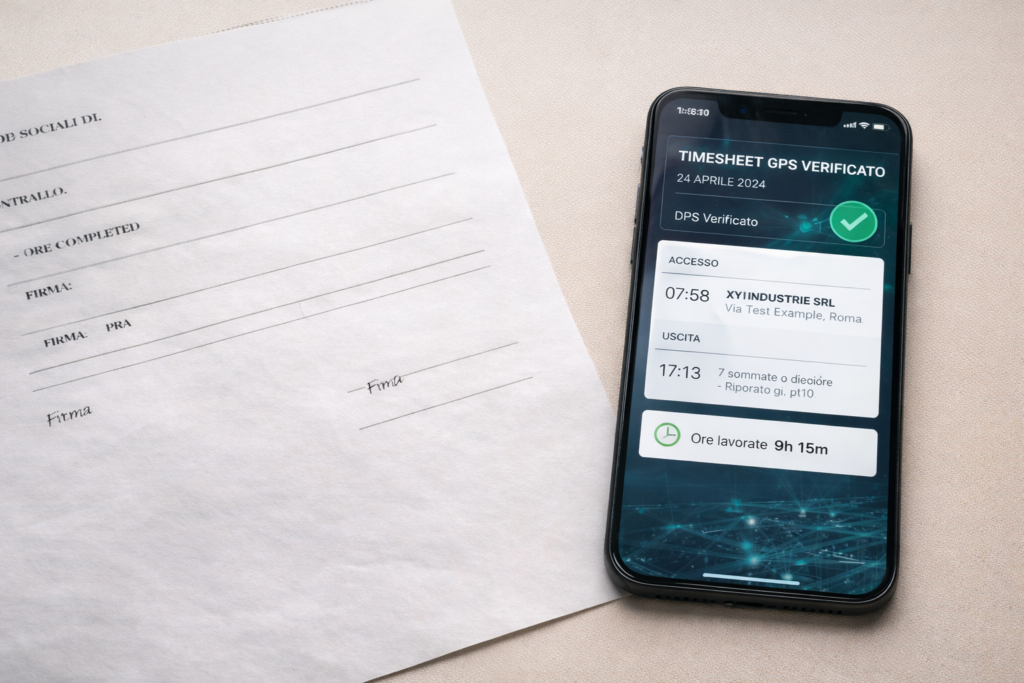
The GPS system with cryptographic hashing solves all three problems: every clock-in is timestamped in real time, geolocated to the site, and cryptographically tamper-proof.
Case study – HR Manager, cleaning company with 35 employees (Turin):
“The
INL inspector asked us to prove the presence of every worker at every site for a period of 90 days. With GeoTapp, I exported everything in 10 minutes. Without that system, I would have spent weeks reconstructing the data, assuming it was even possible.”
How GPS automates compliance
GeoTapp TimeTracker automatically manages all documentation requirements:
- Site-specific clocking in/out: every entry/exit is linked to the specific site via GPS
- Automatic attendance log: available for export to PDF/Excel for any period
- Compliant data retention: data stored on EU servers, with configurable retention periods
- Employee information: the system automatically sends the mandatory notification upon first login
- Reports for inspectors: structured exports by site, worker and period in seconds
The GDPR and GPS in the employment relationship
An often overlooked point: GPS tracking of employees requires a documented balancing of interests, not just a privacy notice.
Try GeoTapp free for 14 days
No credit card required. Get started in 2 minutes.
Start free trial
GeoTapp manages this automatically through:
– A comprehensive information notice to the employee with a digital signature upon
onboarding– Tracking active only during working hours (not outside working hours)
– Employee access to their own data (portability)
– Automatic deletion in accordance with the configured retention policy
Everything is documented and verifiable in the event of a GDPR inspection or trade union dispute.
Checklist: are you compliant?
Check these points for your company:
- [ ] Does every employee have a clock-in record per site (not just a daily total)?
- [ ] Are attendance records kept for at least 2 years?
- [ ] Can you reconstruct the working hours at each site for any day in the last 6 months?
- [ ] Have employees been informed about the attendance tracking system?
- [ ] Is the GPS system GDPR-compliant (only during working hours)?
If you answered ‘no’ to even one of these, you are potentially at risk.
Conclusion: compliance isn’t a cost, it’s insurance
Companies that implement certified time and attendance systems do not do so out of fear of the inspector. They do so because a well-organised system protects everyone: the company from penalties, employees from unfair disputes, and customers from doubts about service quality.
With GeoTapp, compliance is automatic. You don’t have to remember to do anything: the system generates the documentation whilst your technicians are working.
What You Actually Risk in the Event of an Inspection
The penalties for failing to keep records of working hours are not trivial. The National Labour Inspectorate can impose fines ranging from €120 to €600 for each worker for whom documentation is missing or inadequate. If you have ten employees and three months’ worth of records are non-compliant, you’re looking at thousands of euros in fines, on top of legal costs and the time wasted dealing with the inspection.
But the biggest risk isn’t the fine itself, it’s what happens next. An inspection that uncovers documentation irregularities opens a file that can lead to more in-depth checks across your entire HR management. And in sectors such as cleaning, security and facility management, where overtime, variable shifts and multiple sites are the norm, having fragmented or inaccurate documentation is a constant risk.
The Difference Between ‘Compliant’ and ‘Protected’
Being technically compliant with regulations is not the same as being protected in the event of a dispute. A correctly completed paper timesheet is “compliant”, but if an employee lodges a complaint claiming they worked unrecognised hours, that timesheet alone is not enough. You have no way of proving that the recorded data corresponds to reality, because there is no objective data to confirm it.
With GeoTapp, every clock-in is a system record with GPS, an immutable timestamp and anti-spoofing verification. You’re not just filling in a register, you’re creating verifiable evidence of every moment of attendance. If an employee lodges a complaint, you have access to the full history of clock-ins with the certified location for every working day. Not “our log says X”, but “the GPS system says X, with these coordinates, at this timestamp, verified by this certificate.”
Implementing Compliance Without Adding Red Tape
The paradox of compliance is that many companies avoid it because they think it requires more administrative work. In reality, an integrated digital time and attendance system like GeoTapp reduces administrative work rather than increasing it. The technician clocks in using their phone, something they already do as a matter of course, and the system automatically generates all the documentation required by law: start and finish times for each site, weekly and monthly summaries per employee, and a log accessible in the event of an inspection.
You no longer need to collect paper forms, you no longer need to copy data from one system to another, and you no longer need to prepare special reports before inspections because the report is already automatically generated. Compliance becomes a by-product of normal operational workflow, not an additional task. And this completely changes SMEs’ relationship with labour regulations: from a burdensome obligation to an automated process.
Picture the next labour inspection on a Tuesday afternoon, and the attendance register is already prepared, signed and exportable.
Make CCNL compliance a byproduct of the system. Fourteen days, no card.
No credit card, up and running in 2 minutes.
See sector
Get articles like this in your inbox
Practical insights on GPS tracking, field operations and GDPR. No spam, just useful content.